Porpidia speirea (Ach.) Kremp. var. prochsthallina (A. Massal.) Clauzade & Cl. Roux ex Hafellner & Türk
Stapfia, 76: 155, 2001. Basionym: Lecidea elata var. prochsthallina A. Massal. - Ric. Auton. Lich. Crost.: 77, 1852.
Synonyms: Lecidea speirea (Ach.) Ach. var. prochsthallina (A. Massal.) Hertel
Description: Thallus crustose, episubstratic, continuous to rimose, pale yellow, rarely delimited by a thin dark prothallus. Medulla white, I+ blue. Apothecia lecideine, black, 1-2 mm across, at first semi-immersed in the thallus, then broadly sessile, often separated from the thallus by a circular crack or surrounded by a thalline rim, with an initially flat, then strongly convex, not umbonate, usually epruinose disc and a thin, epruinose, finally often excluded proper margin. Proper exciple, when young, with a broad marginal black layer and a narrow inner colourless layer of radiating hyphae, the latter progressively disappearing, leaving a thin, black-brown exciple reacting K-; epithecium brownish green to green-black; hymenium very pale yellowish green to colourless, 70-100 µm high; paraphyses coherent, branched and anastomosing in upper part, 1.5-2.5 µm thick at mid-level, the apical cell to 3.5 µm wide; hypothecium brown-black. Asci 8-spored, elongate-clavate, with a thin, outer amyloid layer and a thickened tholus penetrated by a pore, the sides of which are strongly amyloid, Porpidia-type. Ascospores 1-celled, hyaline, ellipsoid, c.15-20 x 6-8 μm, not halonate. Spot tests: cortex and especially medulla K+ bright yellow, C-, KC-, P+ pale yellow. Chemistry: unknown, but probably with confluentic acid as a major substance, plus other unknowns.
Growth form: Crustose
Substrata: rocks
Photobiont: green algae other than Trentepohlia
Reproductive strategy: mainly sexual
Commonnes-rarity: (info)
Alpine belt: very rare
Subalpine belt: very rare
Montane belt: extremely rare
Dry submediterranean belt: absent
Humid submediterranean belt: absent
Padanian area: absent
pH of the substrata:
1 2 3 4 5

Solar irradiation:
1 2 3 4 5
Aridity:
1 2 3 4 5
Eutrophication:
1 2 3 4 5
Poleotolerance:
0 1 2 3
Altitudinal distribution:
1 2 3 4 5 6
Rarity
absent
extremely rare
very rare
rare
rather rare
rather common
common
very common
extremely common
Loading data...
Occurrence data
Predictive map
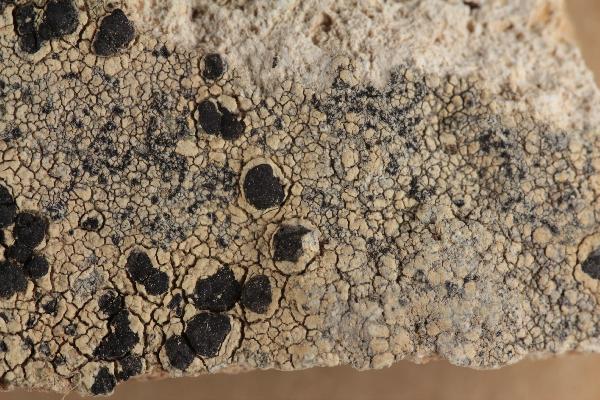
Collezione lichenologica Abramo Massalongo del Museo di Storia Naturale G. Ligabue di Venezia - Autori: Seggi, Linda; Trabucco, Raffaella Proprietà: Fondazione Musei Civici di Venezia - CC BY-NC
Italy, Veneto, in op. Velo Roverè, Prochsthal
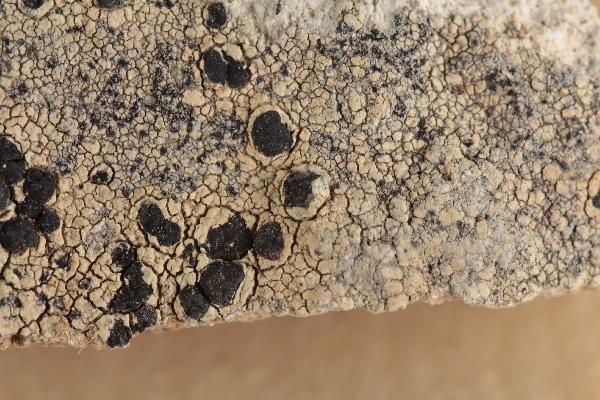
Collezione lichenologica Abramo Massalongo del Museo di Storia Naturale G. Ligabue di Venezia - Autori: Seggi, Linda; Trabucco, Raffaella Proprietà: Fondazione Musei Civici di Venezia - CC BY-NC
Italy, Veneto, in op. Velo Roverè, Prochsthal
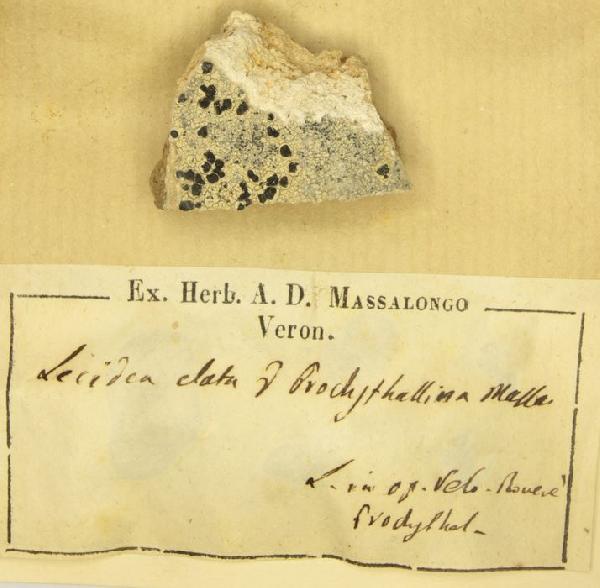
Collezione lichenologica Abramo Massalongo del Museo di Storia Naturale G. Ligabue di Venezia - Autori: Seggi, Linda; Trabucco, Raffaella Proprietà: Fondazione Musei Civici di Venezia - CC BY-NC
Italy, Veneto, in op. Velo Roverè, Prochsthal
Growth form: Crustose
Substrata: rocks
Photobiont: green algae other than Trentepohlia
Reproductive strategy: mainly sexual
Commonnes-rarity: (info)
Alpine belt: very rare
Subalpine belt: very rare
Montane belt: extremely rare
Dry submediterranean belt: absent
Humid submediterranean belt: absent
Padanian area: absent
pH of the substrata:
| 1 | 2 | 3 | 4 | 5 |
Solar irradiation:
| 1 | 2 | 3 | 4 | 5 |
Aridity:
| 1 | 2 | 3 | 4 | 5 |
Eutrophication:
| 1 | 2 | 3 | 4 | 5 |
Poleotolerance:
| 0 | 1 | 2 | 3 |
Altitudinal distribution:
| 1 | 2 | 3 | 4 | 5 | 6 |
Rarity
absent
extremely rare
very rare
rare
rather rare
rather common
common
very common
extremely common
Loading data...
Occurrence data
Predictive map

Collezione lichenologica Abramo Massalongo del Museo di Storia Naturale G. Ligabue di Venezia - Autori: Seggi, Linda; Trabucco, Raffaella Proprietà: Fondazione Musei Civici di Venezia - CC BY-NC
Italy, Veneto, in op. Velo Roverè, Prochsthal

Collezione lichenologica Abramo Massalongo del Museo di Storia Naturale G. Ligabue di Venezia - Autori: Seggi, Linda; Trabucco, Raffaella Proprietà: Fondazione Musei Civici di Venezia - CC BY-NC
Italy, Veneto, in op. Velo Roverè, Prochsthal