Phaeophyscia erythrocardia (Tuck.) Essl.
Mycotaxon, 7, 2: 302, 1978. Basionym: Physcia obscura var. erythrocardia Tuck. - Proc. Amer. Acad. Arts & Sci., 4: 389, 1860.
Synonyms: Physcia erythrocardia (Tuck.) Kashiw.
Description: Thallus foliose, heteromerous, dorsiventral, narrow-lobed, closely adpressed, forming orbicular, rarely irregular, up to 4 cm (usually less) wide rosettes. Lobes elongate and discrete to (rarely) partly imbricate, 0.4-1.2 mm wide, flat, grey to brown-black in sun-forms, turning bright green when wet, epruinose, sometimes with a continuous grey epinecral layer in older parts. Lower surface black, sometimes paler at lobe ends, with simple, black rhizines which often project beyond lobe margins. Upper and lower cortex paraplectenchymatous; medulla reddish. Apothecia frequent, lecanorine to 1-2 mm across, sessile, with a black, usually epruinose disc, and a thalline margin which often has a corona of dark rhizines in the lower part. Epithecium brown; hymenium and hypothecium colourless; paraphyses slender, often forked in upper part, the apical cells clavate, with a thin dark cap. Asci 8-spored, clavate, the K/I+ blue tholus penetrated by a faintly amyloid apical cushion with parallel or diverging flanks, the wall K/I-, surrounded by a K/I+ blue outer layer, Lecanora-type. Ascospores 1-septate, brown, ellipsoid, 20-25(-28) x 9.5-12(-13) µm, Physcia-type. Pycnidia common and usually abundant, black, immersed. Conidia ellipsoid, 2-4 x c. 1 μm. Photobiont chlorococcoid. Spot tests: K-, C-, KC-, P-, UV-; medulla K+ purple-red. Chemistry: medulla with skyrin and zeorin.
Growth form: Foliose, narrow lobed
Substrata: bark
Photobiont: green algae other than Trentepohlia
Reproductive strategy: mainly sexual
Commonnes-rarity: (info)
Alpine belt: absent
Subalpine belt: absent
Montane belt: very rare
Dry submediterranean belt: absent
Humid submediterranean belt: absent
Padanian area: absent
pH of the substrata:
1 2 3 4 5

Solar irradiation:
1 2 3 4 5
Aridity:
1 2 3 4 5
Eutrophication:
1 2 3 4 5
Poleotolerance:
0 1 2 3
Altitudinal distribution:
1 2 3 4 5 6
Rarity
absent
extremely rare
very rare
rare
rather rare
rather common
common
very common
extremely common
Loading data...
Occurrence data
Predictive map
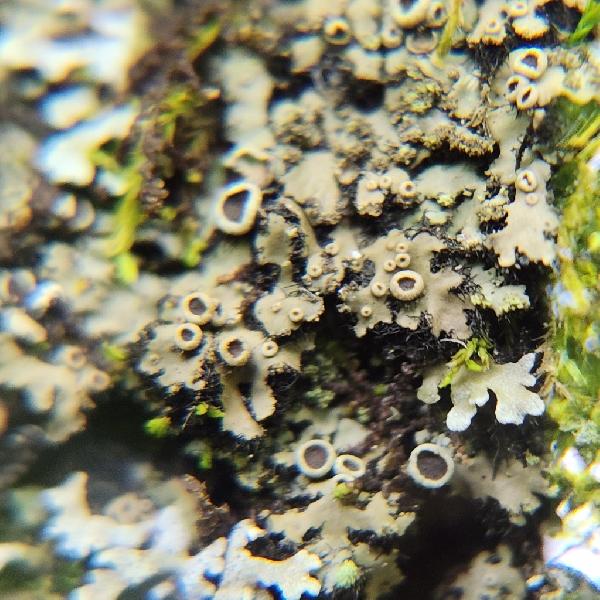
Connor Johanson – CC BY-NC
USA, Wisconsin
Source: https://www.inaturalist.org/observations/222330999
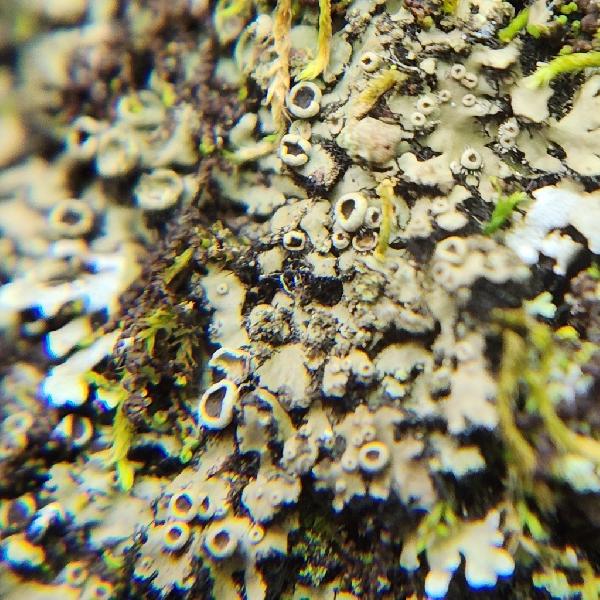
Connor Johanson – CC BY-NC
USA, Wisconsin
Source: https://www.inaturalist.org/observations/222330999
Growth form: Foliose, narrow lobed
Substrata: bark
Photobiont: green algae other than Trentepohlia
Reproductive strategy: mainly sexual
Commonnes-rarity: (info)
Alpine belt: absent
Subalpine belt: absent
Montane belt: very rare
Dry submediterranean belt: absent
Humid submediterranean belt: absent
Padanian area: absent
pH of the substrata:
| 1 | 2 | 3 | 4 | 5 |
Solar irradiation:
| 1 | 2 | 3 | 4 | 5 |
Aridity:
| 1 | 2 | 3 | 4 | 5 |
Eutrophication:
| 1 | 2 | 3 | 4 | 5 |
Poleotolerance:
| 0 | 1 | 2 | 3 |
Altitudinal distribution:
| 1 | 2 | 3 | 4 | 5 | 6 |
Rarity
absent
extremely rare
very rare
rare
rather rare
rather common
common
very common
extremely common
Loading data...
Occurrence data
Predictive map

Connor Johanson – CC BY-NC
USA, Wisconsin
Source: https://www.inaturalist.org/observations/222330999