Buellia longispora Scheid.
Lichenologist, 25: 352, 1993.
Synonyms:
Description: Thallus crustose, episubstratic, granular to bullate, whitish, delimited by a black prothallus, growing on the thalli of other crustose lichens. Medulla strongly amyloid, I+ blue. Apothecia lecideine, black, 0.5-1 mm across, sessile and constricted at base, with a flat to strongly convex disc and a thin, finally excluded proper margin. Proper exciple Dispersa-type, of radially arranged hyphae, the inner part of long-celled, parallel, strongly agglutinated and thick-walled hyphae, the outer part of short-celled, isodiametric hyphae without intercellular spaces; epithecium brown; hymenium colourless, without oil droplets, c. 85 µm high; hypothecium dark brown. Asci 8-spored, clavate to cylindrical-clavate, the apical dome K/I+ dark blue with a pale, conical-pointed apical cushion (axial mass), the wall I-, but the thin outer gel I+ blue, Bacidia-type. Ascospores 1-3-septate (pluriseptate only when overmature), brown, narrowly oblong, not constricted at septum, 15-30 x 7-10 µm, Buellia-type, with a rugulate ornamentation. Pycnidia black, immersed in thallus. Conidia bacilliform, 5-5.7 µm long. Photobiont chlorococcoid. Spot tests: thallus K+ yellow turning red (with crystals), C-, KC-, P- or P+ faintly yellow. Chemistry: atranorin, norstictic acid with connorstictic acid, stictic acid with cryptostictic, constictic and menegazziaic acids.
Growth form: Crustose
Substrata: rocks
Photobiont: green algae other than Trentepohlia
Reproductive strategy: mainly sexual
Commonnes-rarity: (info)
Alpine belt: absent
Subalpine belt: absent
Montane belt: absent
Dry submediterranean belt: extremely rare
Humid submediterranean belt: very rare
Padanian area: absent
pH of the substrata:
1 2 3 4 5

Solar irradiation:
1 2 3 4 5
Aridity:
1 2 3 4 5
Eutrophication:
1 2 3 4 5
Poleotolerance:
0 1 2 3
Altitudinal distribution:
1 2 3 4 5 6
Rarity
absent
extremely rare
very rare
rare
rather rare
rather common
common
very common
extremely common
Loading data...
Occurrence data
Predictive map
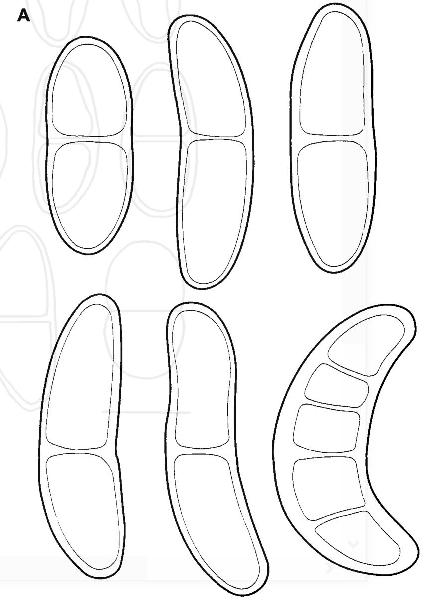
Source: Scheidegger C. (1993) Lichenologist 25(4):315-364 A revision of European saxicolous species of the genus Buellia De Not. and formerly included genera.
Growth form: Crustose
Substrata: rocks
Photobiont: green algae other than Trentepohlia
Reproductive strategy: mainly sexual
Commonnes-rarity: (info)
Alpine belt: absent
Subalpine belt: absent
Montane belt: absent
Dry submediterranean belt: extremely rare
Humid submediterranean belt: very rare
Padanian area: absent
pH of the substrata:
| 1 | 2 | 3 | 4 | 5 |
Solar irradiation:
| 1 | 2 | 3 | 4 | 5 |
Aridity:
| 1 | 2 | 3 | 4 | 5 |
Eutrophication:
| 1 | 2 | 3 | 4 | 5 |
Poleotolerance:
| 0 | 1 | 2 | 3 |
Altitudinal distribution:
| 1 | 2 | 3 | 4 | 5 | 6 |
Rarity
absent
extremely rare
very rare
rare
rather rare
rather common
common
very common
extremely common
Loading data...
Occurrence data
Predictive map