Acarospora sulphurata var. rubescens Buschardt
in Leuckert & Buschardt, Nova Hedwigia, 30: 802, 1978.
Synonyms:
Description: Thallus crustose, areolate-placodioid, bright yellow to (rarely) greenish yellow in shade-forms, matt, forming up to 4 cm wide rosettes. Lobes 0.5-1 mm wide, crenate, mostly flat; central areoles irregular in shape, c. 1 mm wide, contiguous, flat to subconvex, separated by deep fissures. Cortex 35-50 µm thick, opaque, with more or less perpendicularly aarranged hyphae; algal layer continuous; medulla white, 135-170 µm thick, with crystals dissolving in K. Apothecia lecanorine, up to 10 per areole, at first punctiform and immersed, then slightly expanded, 0.1-0.3 mm across, with a yellowish brown, round to irregular, flat to slightly concave disc and a thin, often indistinct margin. Proper exciple indistinct or to 15 µm wide; epithecium yellowish green to yellowish brown; hymenium colourless, 100-120 µm high; paraphyses 2-2.5 µm thick, the apical cells hardly swollen. Asci >100-spored, clavate, the apical dome conspicuous, K/I-. Ascospores 1-celled, hyaline, globose to subglobose, 2-4(-5.5) x 2-3(-4) µm. Photobiont chlorococcoid. Spot tests: cortex K+ yellow turning red (needle-like crystals), C-, KC-, P- or P+ yellow; medulla K-. Chemistry: upper cortex with rhizocarpic and norstictic acids.
Growth form: Crustose placodiomorph
Substrata: rocks
Photobiont: green algae other than Trentepohlia
Reproductive strategy: mainly sexual
Subcontinental: restricted to areas with a dry-subcontinental climate (e.g. dry Alpine valleys, parts of Mediterranean Italy)
Poorly known taxon in need of further study
Commonnes-rarity: (info)
Alpine belt: absent
Subalpine belt: absent
Montane belt: extremely rare
Dry submediterranean belt: extremely rare
Humid submediterranean belt: absent
Padanian area: absent
pH of the substrata:
1 2 3 4 5

Solar irradiation:
1 2 3 4 5
Aridity:
1 2 3 4 5
Eutrophication:
1 2 3 4 5
Poleotolerance:
0 1 2 3
Altitudinal distribution:
1 2 3 4 5 6
Rarity
absent
extremely rare
very rare
rare
rather rare
rather common
common
very common
extremely common
Loading data...
Occurrence data
Predictive map
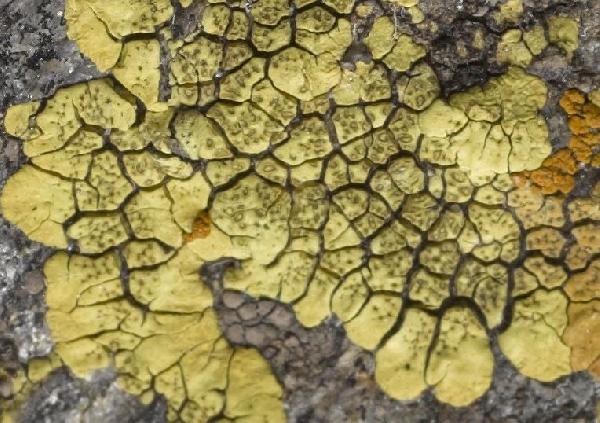
Modified from the original at: https://gzu.jacq.org/GZU000294856
GZU 000294856 - Leg. A. Buschardt - Date 1972-07-12
Location Italy
Label Südtirol: Vinschgau, Trockenhänge dicht oberhalb Eyrs ; Alt. 1050 m
Growth form: Crustose placodiomorph
Substrata: rocks
Photobiont: green algae other than Trentepohlia
Reproductive strategy: mainly sexual
Subcontinental: restricted to areas with a dry-subcontinental climate (e.g. dry Alpine valleys, parts of Mediterranean Italy)
Poorly known taxon in need of further study
Commonnes-rarity: (info)
Alpine belt: absent
Subalpine belt: absent
Montane belt: extremely rare
Dry submediterranean belt: extremely rare
Humid submediterranean belt: absent
Padanian area: absent
pH of the substrata:
| 1 | 2 | 3 | 4 | 5 |
Solar irradiation:
| 1 | 2 | 3 | 4 | 5 |
Aridity:
| 1 | 2 | 3 | 4 | 5 |
Eutrophication:
| 1 | 2 | 3 | 4 | 5 |
Poleotolerance:
| 0 | 1 | 2 | 3 |
Altitudinal distribution:
| 1 | 2 | 3 | 4 | 5 | 6 |
Rarity
absent
extremely rare
very rare
rare
rather rare
rather common
common
very common
extremely common
Loading data...
Occurrence data
Predictive map