Carbonea intrudens (H. Magn.) Hafellner
Fritschiana, 52: 40, 2006. Basionym: Lecidea intrudens H. Magn. - Ark. Bot., 33, A, 1: 53, 1946.
Synonyms: Carbonea halacsyi sensu Hafellner & Sancho non Lecidea halacsyi J. Steiner
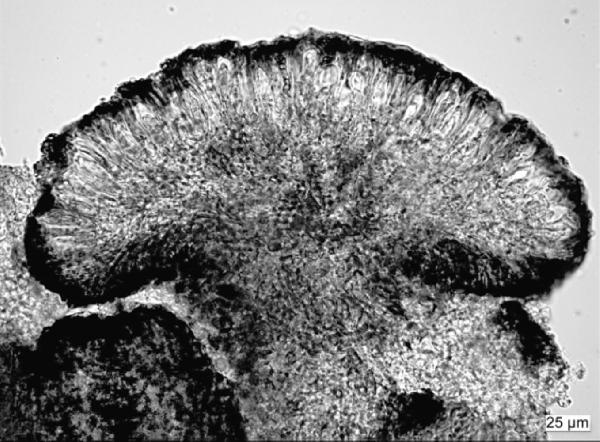
Description: Thallus indistinct, doubtfully lichenized, immersed in the thalli of Rhizocarpon-species and other crustose lichens, which often appear darkened or bleached in the infected parts. Apothecia biatorine, black, 0.3-0.5 mm across, broadly attached, often clustered on the edge of the host’s areoles or on its hypothallus, with a soon convex, somewhat glossy disc, without a distinct proper margin. Proper exciple green-black in outer part, dark brown within, 30-50 μm wide, of radially arranged hyphae, K-, N+ orange-brown; epithecium blue green or emerald-green, c. 10 μm high, K+ emerald green, N+ blue; hymenium colourless or greenish in upper part, 40-55 μm high, I+ blue turning red-brown; paraphyses conglutinated, simple or sparingly branched and anastomosing, 2-2.5 mm thick, the apical cell only slightly enlarged and surrounded by blue-green pigment; hypothecium dark brown to brown, 50-120 μm high, K+ purple, N+ orange-brown. Asci 8-spored, clavate, the K/I+ blue tholus penetrated by a faintly amyloid apical cushion with parallel or diverging flanks, the outer wall very thin, K/I-, surrounded by a K/I+ blue outer layer, Lecanora-type. Ascospores 1-celled (rarely old spores 1-septate), hyaline, ellipsoid to oblong, 8-12(-16) x 3-5 μm. Photobiont absent (some authors report an epicapylic thallus with chlorococcoid photobiont). Spot tests: all negative. Chemistry: without lichen substances.
Growth form: Crustose
Substrata: rocks
Photobiont: green algae other than Trentepohlia
Reproductive strategy: mainly sexual
paras yellow Rhizocarpon species
Commonnes-rarity: (info)
Alpine belt: extremely rare
Subalpine belt: extremely rare
Montane belt: absent
Dry submediterranean belt: absent
Humid submediterranean belt: absent
Padanian area: absent
pH of the substrata:
1 2 3 4 5

Solar irradiation:
1 2 3 4 5
Aridity:
1 2 3 4 5
Eutrophication:
1 2 3 4 5
Poleotolerance:
0 1 2 3
Altitudinal distribution:
1 2 3 4 5 6
Rarity
absent
extremely rare
very rare
rare
rather rare
rather common
common
very common
extremely common
Loading data...
Occurrence data
Predictive map
Source: HAFELLNER J. 2006: Lecideoid lecanoralean ascomycetes invading Rhizocarpon subgen. Rhizocarpon taxa, with special emphasis on cryptothalline species. – Fritschiana (Graz) 52: 31–48
Growth form: Crustose
Substrata: rocks
Photobiont: green algae other than Trentepohlia
Reproductive strategy: mainly sexual
paras yellow Rhizocarpon species
Commonnes-rarity: (info)
Alpine belt: extremely rare
Subalpine belt: extremely rare
Montane belt: absent
Dry submediterranean belt: absent
Humid submediterranean belt: absent
Padanian area: absent
pH of the substrata:
| 1 | 2 | 3 | 4 | 5 |
Solar irradiation:
| 1 | 2 | 3 | 4 | 5 |
Aridity:
| 1 | 2 | 3 | 4 | 5 |
Eutrophication:
| 1 | 2 | 3 | 4 | 5 |
Poleotolerance:
| 0 | 1 | 2 | 3 |
Altitudinal distribution:
| 1 | 2 | 3 | 4 | 5 | 6 |
Rarity
absent
extremely rare
very rare
rare
rather rare
rather common
common
very common
extremely common
Loading data...
Occurrence data
Predictive map