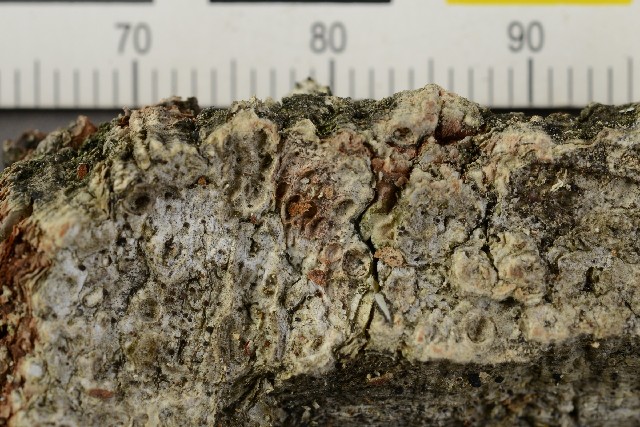
Catinaria neuschildii (Körb.) P. James
Lichenologist, 3: 97, 1965. Basionym: Biatorina neuschildii Körb. - Parerga Lichenol.: 143, 1860.
Synonyms: Biatorina subpulicaris Anzi; Catillaria atropurpurea subsp. neuschildii (Körb.) Th. Fr.; Catillaria neuschildii (Körb.) Th. Fr.; Catillaria subpulicaris (Anzi) Lettau
Description: Thallus crustose, endosubstratic or thinly episubstratic, often minutely granular (granules 15-70 µm in diam.), pale to dark grey-brown, greenish white, or grey-green, sometimes poorly evident. Apothecia biatorine, broadly adnate or slightly constricted at base, 0.2-0.5 mm across, with a concave to slightly convex, reddish brown (when dry) to black (when wet), epruinose disc, and a raised, concolorous or darker, rather thick, finally sometimes excluded proper margin. Proper exciple dark brown to violet-red in outer part, colourless to pale brown within, of radiating, conglutinated hyphae with ellipsoid to oblong lumina; epithecium pale yellow to brown, K-, N-; hymenium colourless, 60-80 µm high; paraphyses simple or sparingly branched in lower part, rather lax, 0.8-1 µm thick at mid-level, the apical cells 2-4 µm wide, often with a dark brown cap; hypothecium colourless or pale brown, K-. Asci (8-)12-16-spored, subcylindrical, with a K/I+ blue outer coat and a K/I+ uniformly blue apical dome, approaching the Catillaria-type, but with a non-amyloid axial mass and a small ocular chamber, with biseriately arranged spores. Ascospores 1-septate, hyaline, ellipsoid or oblong-ellipsoid, often slightly constricted at septum, 9-13 x 5-6 µm, with up to 1.5 µm thick, layered walls. Photobiont chlorococcoid (Dictyochloropsis), the cells 5-9 µm in diam. Spot tests: thallus K-, C-, KC-, P-, UV-. Chemistry: without lichen substances.
Growth form: Crustose
Substrata: bark
Photobiont: Trentepohlia
Reproductive strategy: mainly sexual
Most common in areas with a humid-warm climate (e.g. most of Tyrrenian Italy)
In underhangs rarely wetted by rain
Poorly known taxon in need of further study
Commonnes-rarity: (info)
Alpine belt: absent
Subalpine belt: absent
Montane belt: extremely rare
Dry submediterranean belt: very rare
Humid submediterranean belt: very rare
Padanian area: absent
pH of the substrata:
1 2 3 4 5

Solar irradiation:
1 2 3 4 5
Aridity:
1 2 3 4 5
Eutrophication:
1 2 3 4 5
Poleotolerance:
0 1 2 3
Altitudinal distribution:
1 2 3 4 5 6
Rarity
absent
extremely rare
very rare
rare
rather rare
rather common
common
very common
extremely common
Loading data...
Occurrence data
Predictive map
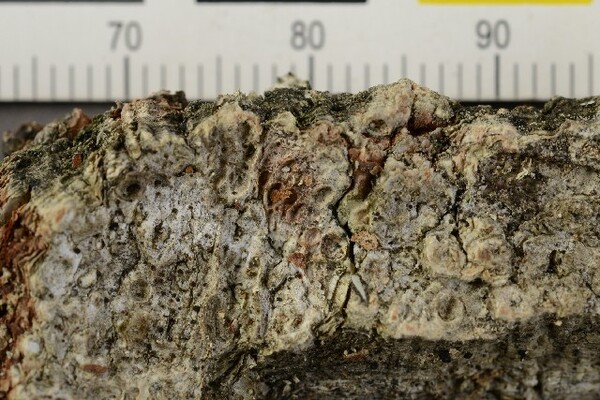
Natural History Museum, University of Oslo, Norway - CC BY-SA NC
Growth form: Crustose
Substrata: bark
Photobiont: Trentepohlia
Reproductive strategy: mainly sexual
Most common in areas with a humid-warm climate (e.g. most of Tyrrenian Italy)
In underhangs rarely wetted by rain
Poorly known taxon in need of further study
Commonnes-rarity: (info)
Alpine belt: absent
Subalpine belt: absent
Montane belt: extremely rare
Dry submediterranean belt: very rare
Humid submediterranean belt: very rare
Padanian area: absent
pH of the substrata:
| 1 | 2 | 3 | 4 | 5 |
Solar irradiation:
| 1 | 2 | 3 | 4 | 5 |
Aridity:
| 1 | 2 | 3 | 4 | 5 |
Eutrophication:
| 1 | 2 | 3 | 4 | 5 |
Poleotolerance:
| 0 | 1 | 2 | 3 |
Altitudinal distribution:
| 1 | 2 | 3 | 4 | 5 | 6 |
Rarity
absent
extremely rare
very rare
rare
rather rare
rather common
common
very common
extremely common
Loading data...
Occurrence data
Predictive map