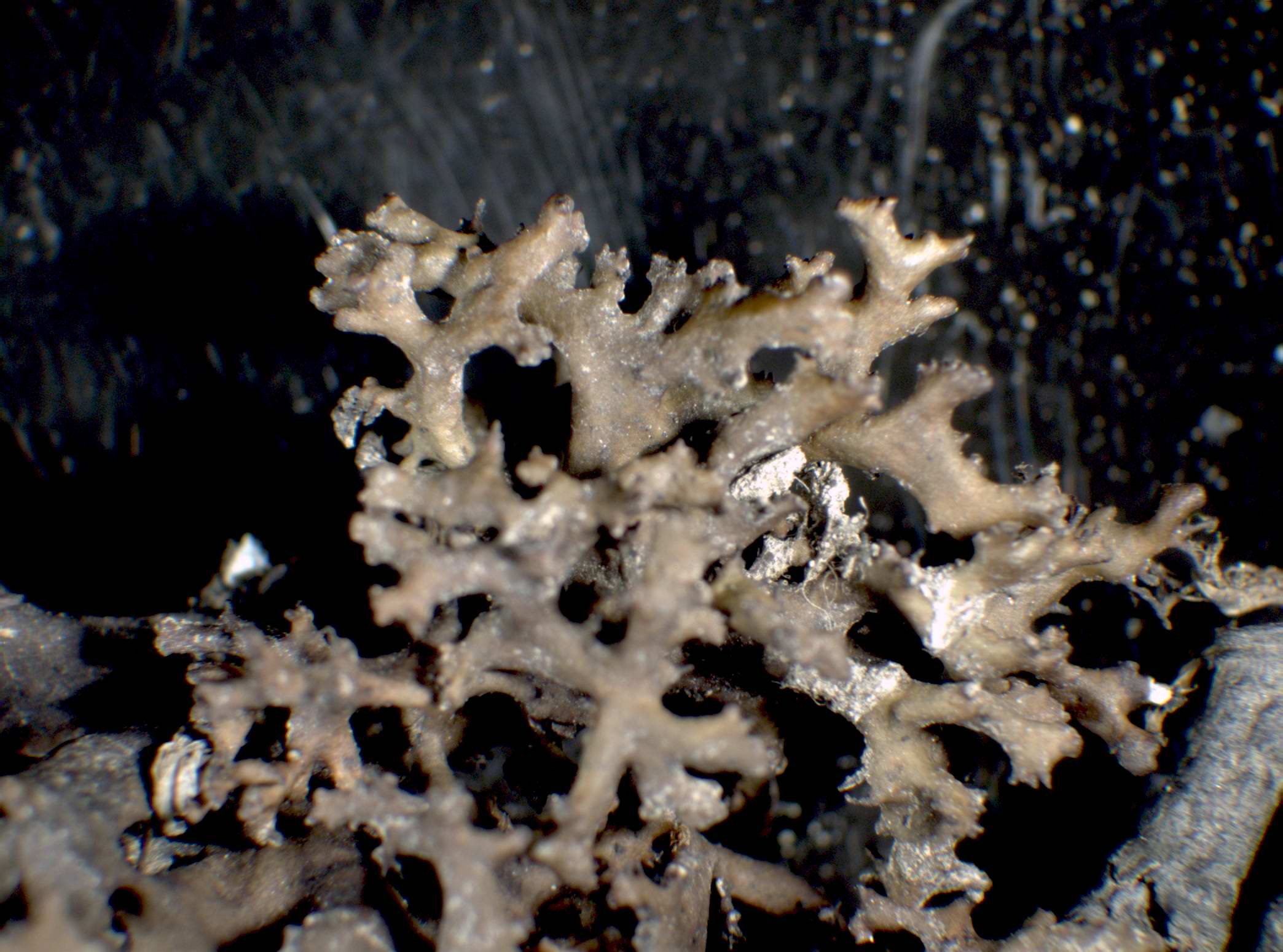
Cetraria obtusata (Schaer.) van den Boom & Sipman
Lichenologist, 26: 106, 1994. Basionym: Cetraria aculeata var. obtusata Schaer. - Lich. Helv. Spicil., 4-5: 225, 1823.
Synonyms:
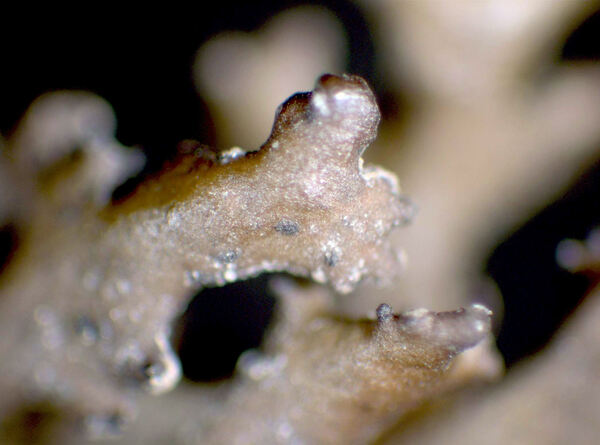
Description: Thallus fruticose, dichotomously to irregularly branched, matt to glossy brown, forming loosely attached, 1-3 cm high tufts. Branches terete or slightly flattened, erect or prostrate, 0.3-1(-2) mm wide, without main stems, with obtuse tips, the margins with c. 0.1 mm thick, up to 1 mm long spinulose outgrowths. Pseudocyphellae rounded, punctiform, often surrounded by black projections. Cortex 2-layered, with an outer, brownish, paraplectenchymatous layer, and an inner, colourless layer of periclinally oriented hyphae: medulla arachnoid, lax, pale yellow. Apothecia unknown. Pycnidia dark, brought on spinulose outgrowths. Conidia simple, elongate, swollen in the middle, 6-7 x 1-1.5 µm. Photobiont chlorococcoid. Spot tests: cortex K-, C-, KC-, P-, UV-; medulla K-, C+ yellow-orange, KC+ yellow, P-, UV-. Chemistry: medulla with secalonic acid C, and two unidentified substances.
Growth form: Fruticose
Substrata: soil, terricolous mosses, and plant debris
Photobiont: green algae other than Trentepohlia
Reproductive strategy: mainly asexual, by thallus fragmentation
Commonnes-rarity: (info)
Alpine belt: very rare
Subalpine belt: absent
Montane belt: absent
Dry submediterranean belt: absent
Humid submediterranean belt: absent
Padanian area: absent
pH of the substrata:
1 2 3 4 5

Solar irradiation:
1 2 3 4 5
Aridity:
1 2 3 4 5
Eutrophication:
1 2 3 4 5
Poleotolerance:
0 1 2 3
Altitudinal distribution:
1 2 3 4 5 6
Rarity
absent
extremely rare
very rare
rare
rather rare
rather common
common
very common
extremely common
Loading data...
Occurrence data
Predictive map
P.L. Nimis CC BY-SA 4.0
TSB 34439
P.L. Nimis; Owner: Department of Life Sciences, University of Trieste
Herbarium: TSB (34439)
2002/01/14
Growth form: Fruticose
Substrata: soil, terricolous mosses, and plant debris
Photobiont: green algae other than Trentepohlia
Reproductive strategy: mainly asexual, by thallus fragmentation
Commonnes-rarity: (info)
Alpine belt: very rare
Subalpine belt: absent
Montane belt: absent
Dry submediterranean belt: absent
Humid submediterranean belt: absent
Padanian area: absent
pH of the substrata:
| 1 | 2 | 3 | 4 | 5 |
Solar irradiation:
| 1 | 2 | 3 | 4 | 5 |
Aridity:
| 1 | 2 | 3 | 4 | 5 |
Eutrophication:
| 1 | 2 | 3 | 4 | 5 |
Poleotolerance:
| 0 | 1 | 2 | 3 |
Altitudinal distribution:
| 1 | 2 | 3 | 4 | 5 | 6 |
Rarity
absent
extremely rare
very rare
rare
rather rare
rather common
common
very common
extremely common
Loading data...
Occurrence data
Predictive map

P.L. Nimis CC BY-SA 4.0
TSB 34439