Circinaria reagens (Zahlbr.) A. Nordin
in Roux & al., Bull. Soc. linn. Provence, 67: 179, 2016.. Basionym: Lecanora calcarea f. reagens Zahlbr. - Österr. bot. Z., 59: 501, 1909.
Synonyms: Aspicilia calcarea var. reagens (Zahlbr.) Szatala; Aspicilia nicaeensis B. de Lesd.; Circinaria calcarea var. reagens (Zahlbr.); Pachyospora viridescens var. calcarea A. Massal.
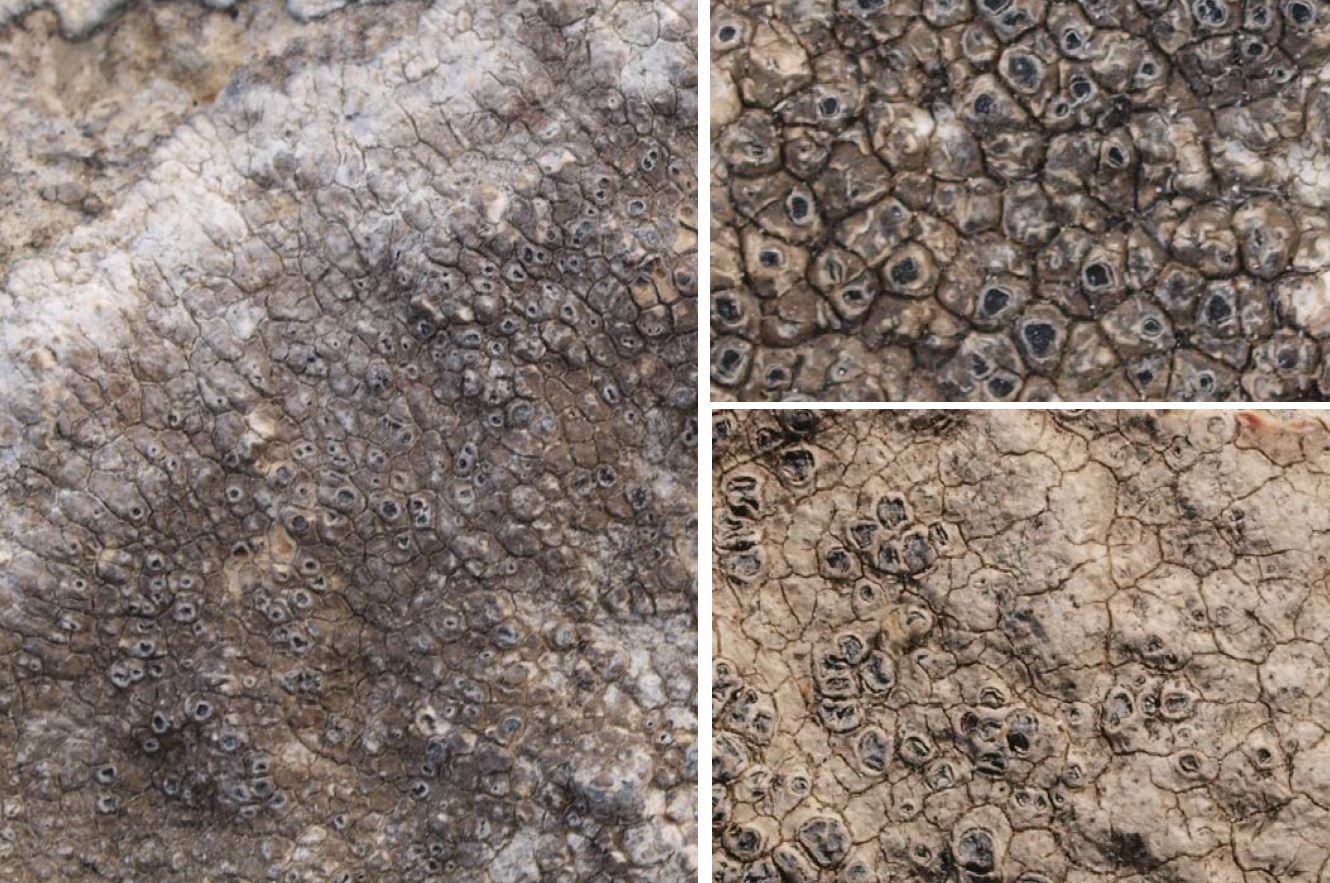
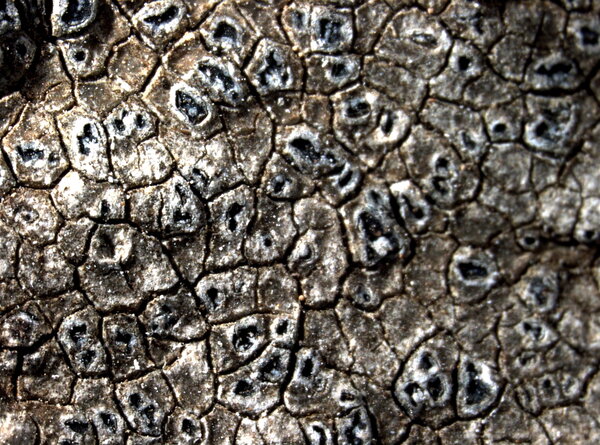
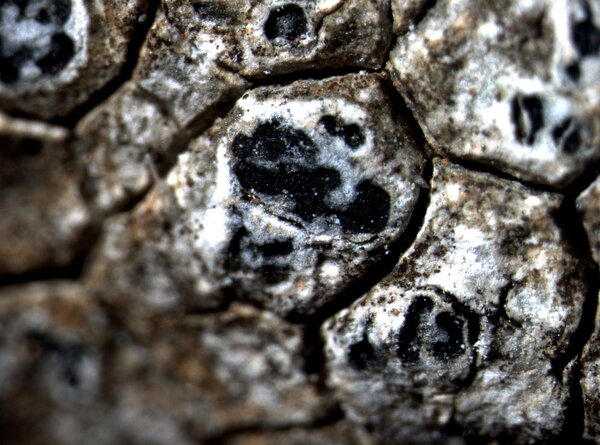
Description: Thallus crustose, episubstratic, white to brown-grey, rimose-areolate to areolate, 0.25-0.8 mm thick, sometimes delimited by a dark, more or less zoned prothallus, forming more or less orbicular patches, the areoles angular, smooth, the peripheral ones often longer than wide and radially arranged. Cortex brownish in upper part (with the Subdepressa-brown pigment), not entirely filled with crystals; algal layer 40-55 µm thick; medulla white, 0.25-0.3 mm thick, I-. Apothecia aspicilioid, immersed, 1(-4) per areole, round or slightly irregular in size and shape, from punctiform to slightly elongate, 0.2-0.8 mm across, with a concave to flat, black, sometimes slightly blue-pruinose disc, and a 0.05-0.15 mm thick, chalky-white, slightly raised, finally often excluded thalline margin. Thalline exciple corticate, the outer part with the Subdepressa-brown pigment; proper exciple very thin, colourless; epithecium olive-green, N+ brighter green, K+ brown; hymenium colourless, 100-120 µm thick, inspersed, I+ blue soon turning red-brown; paraphyses septate and anastomosing, sometimes moniliform in upper part; hypothecium colourless. Asci (2-)4(-6)-spored, the thin outer coat K/I+ blue, the wall and apical dome K/I-. Ascospores 1-celled, hyaline, broadly ellipsoid to subglobose, 18-30 x 14-28 µm. Pycnidia immersed, appearing as black dots. Conidia (5.5-)7-13.5 x (0.5-)1(-1.5 µm). Photobiont chlorococcoid. Spot tests: thallus K+ yellow turning red (needle-like crystals) or K+ yellow then sometimes orange-brown, C-, KC-, P+ yellow-orange. Chemistry: norstictic acid and stictic acid in variable amounts, aspicilin.
Growth form: Crustose
Substrata: rocks
Photobiont: green algae other than Trentepohlia
Reproductive strategy: mainly sexual
Commonnes-rarity: (info)
Alpine belt: absent
Subalpine belt: absent
Montane belt: rather rare
Dry submediterranean belt: very rare
Humid submediterranean belt: very rare
Padanian area: absent
pH of the substrata:
1 2 3 4 5

Solar irradiation:
1 2 3 4 5
Aridity:
1 2 3 4 5
Eutrophication:
1 2 3 4 5
Poleotolerance:
0 1 2 3
Altitudinal distribution:
1 2 3 4 5 6
Rarity
absent
extremely rare
very rare
rare
rather rare
rather common
common
very common
extremely common
Loading data...
Occurrence data
Predictive map
Pier Luigi Nimis - CC BY-SA 4.0
TSB 32071
Pier Luigi Nimis - CC BY-SA 4.0
TSB 32071
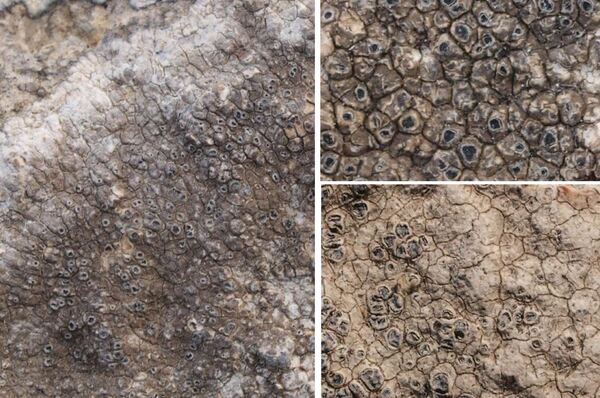
M. Bertrand - Source: Roux C., Bertrand M., Nordin A. 2016. Aspicilia serenensis Cl. Roux et M. Bertrand sp. nov., espèce nouvelle de lichen (groupe d’A. calcarea, Megasporaceae). Bull. Soc. linn. Provence, 67: 165-182.
Growth form: Crustose
Substrata: rocks
Photobiont: green algae other than Trentepohlia
Reproductive strategy: mainly sexual
Commonnes-rarity: (info)
Alpine belt: absent
Subalpine belt: absent
Montane belt: rather rare
Dry submediterranean belt: very rare
Humid submediterranean belt: very rare
Padanian area: absent
pH of the substrata:
| 1 | 2 | 3 | 4 | 5 |
Solar irradiation:
| 1 | 2 | 3 | 4 | 5 |
Aridity:
| 1 | 2 | 3 | 4 | 5 |
Eutrophication:
| 1 | 2 | 3 | 4 | 5 |
Poleotolerance:
| 0 | 1 | 2 | 3 |
Altitudinal distribution:
| 1 | 2 | 3 | 4 | 5 | 6 |
Rarity
absent
extremely rare
very rare
rare
rather rare
rather common
common
very common
extremely common
Loading data...
Occurrence data
Predictive map

Pier Luigi Nimis - CC BY-SA 4.0
TSB 32071
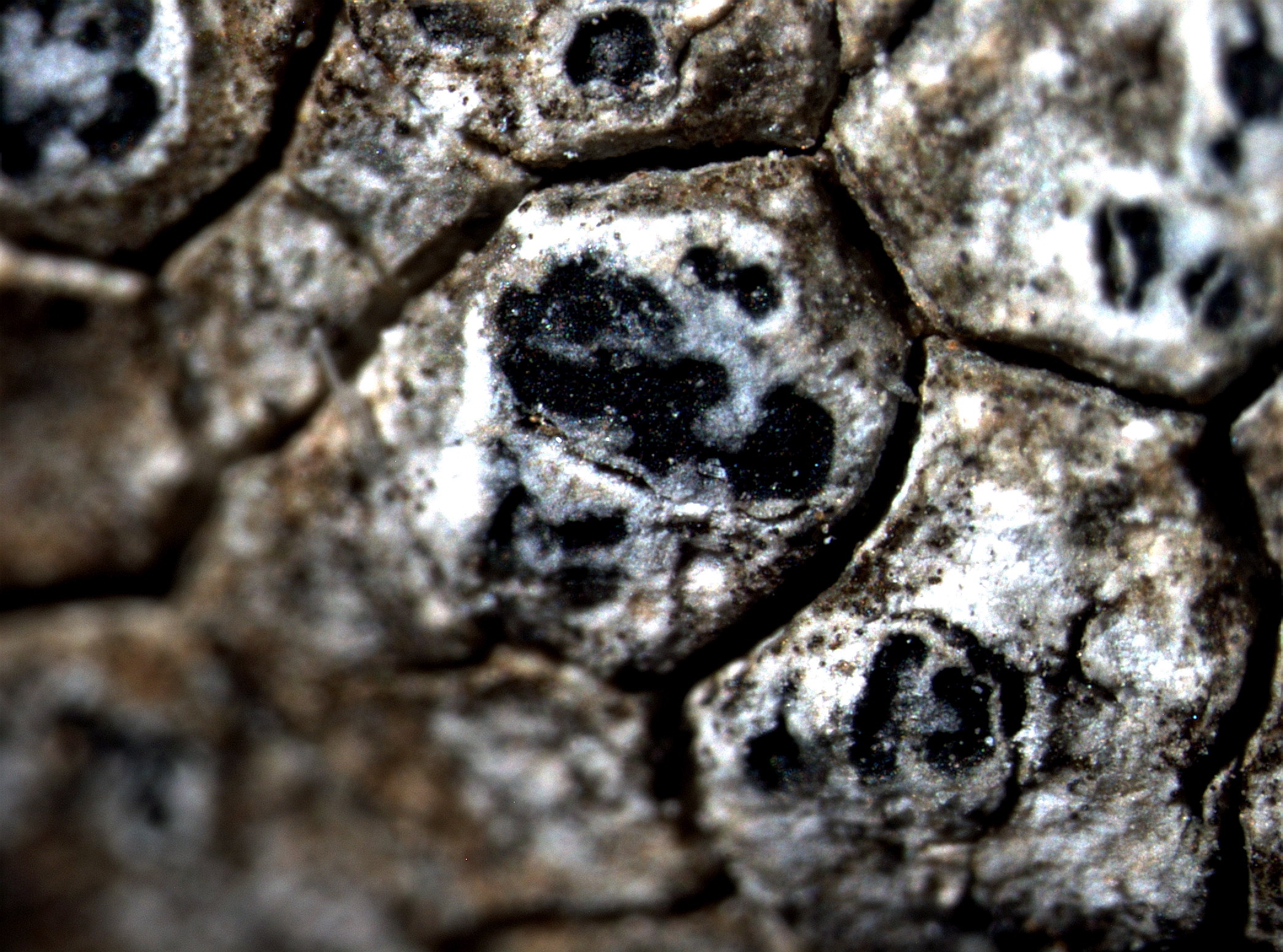
Pier Luigi Nimis - CC BY-SA 4.0
TSB 32071