Cladonia ecmocyna Leight.
Ann. Mag. Nat. Hist., ser. 3, 18: 406, 1866.
Synonyms: Cladonia elongata var. ecmocyna (Leight.) Räsänen; Cladonia gracilis var. ecmocyna (Leight.) Kernst.
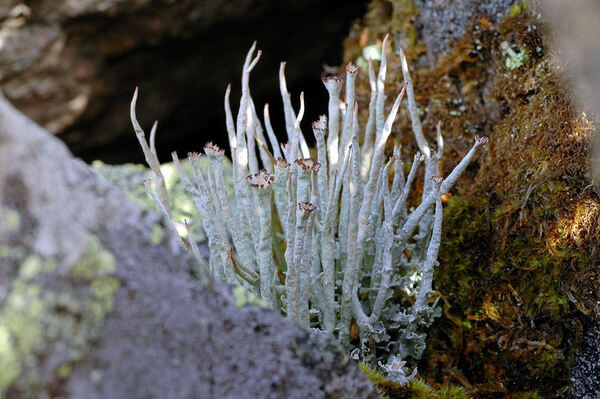
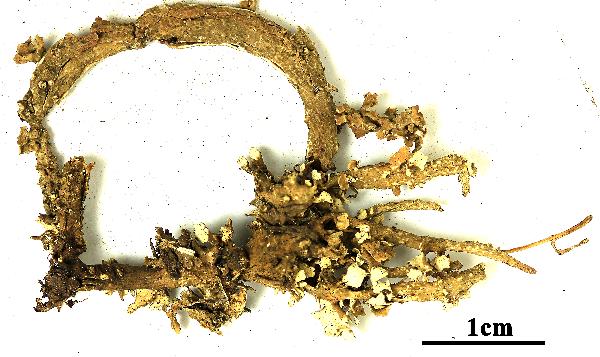
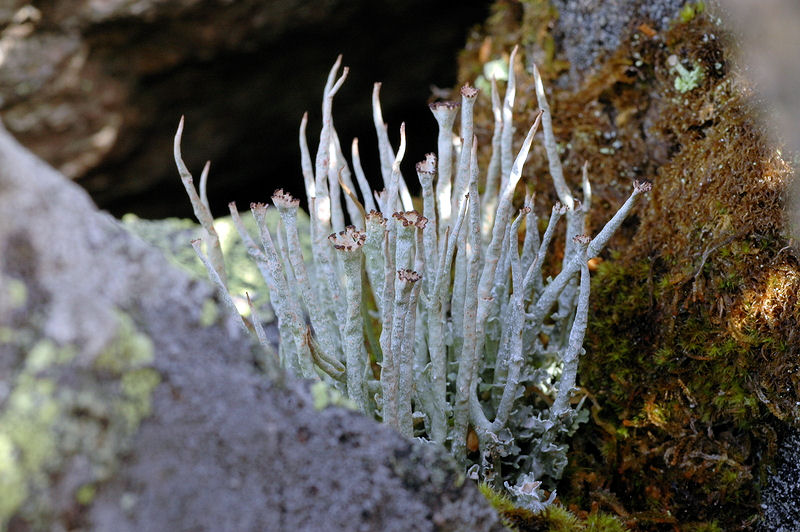
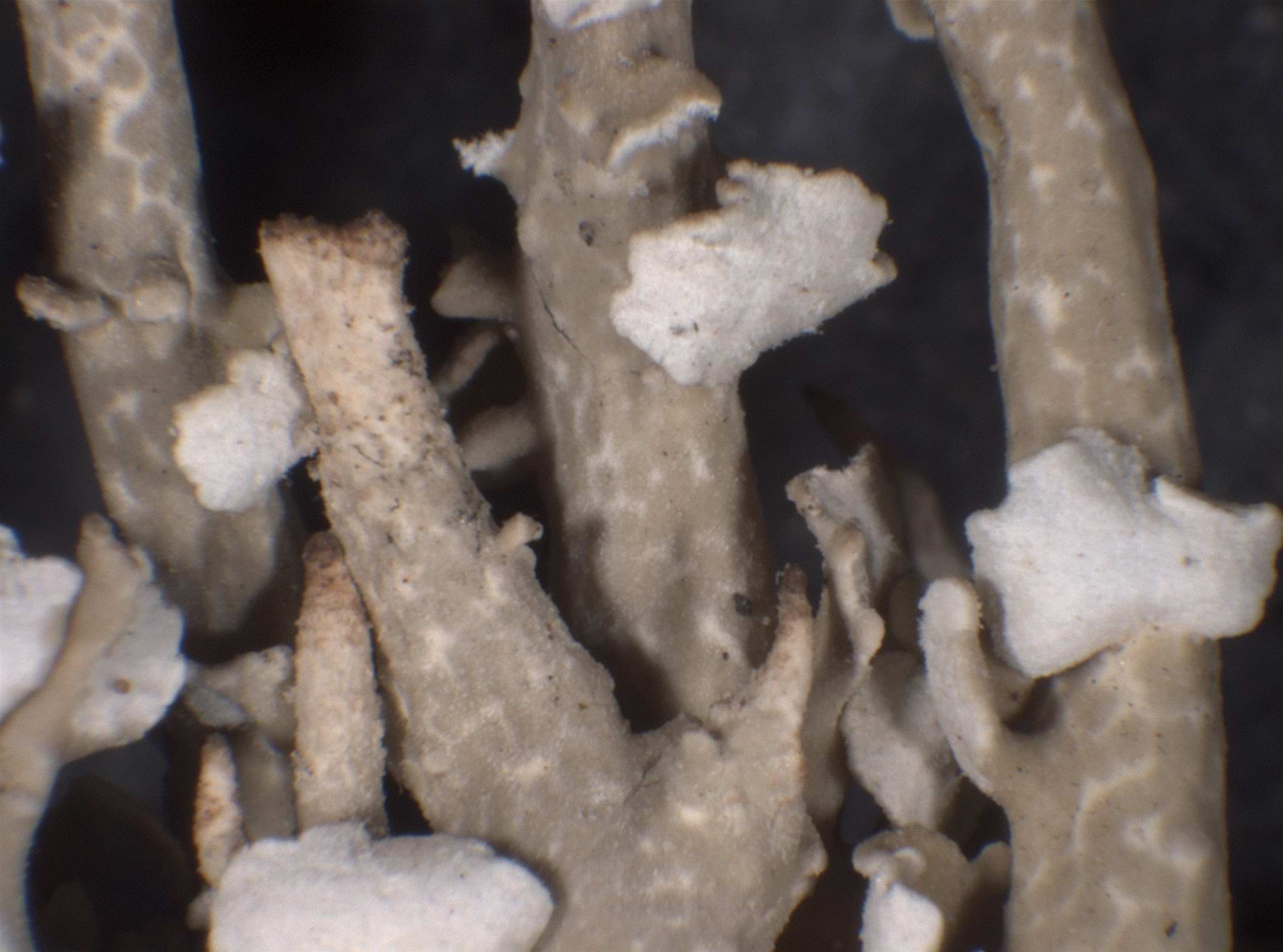
Description: Primary thallus squamulose, ephemeral, the squamules middle-sized, 1-4(-5) mm long, greenish brown to greenish grey above, pure white beneath. Podetia elongate, hollow inside, dull glaucous green, greenish grey or greenish brown in sun-forms, sometimes browned or weakly pruinose at the tips, often yellowish at the emorient bases, 5-10 cm tall, 0.5-4(-5) mm thick, cupless or with narrow (1.5-5 mm wide) cups, esquamulose or sparsely squamulose in lower parts, the cortex subcontinuous to checkered-areolate, the areoles often separated by a network of white medullary interspaces. Apothecia rare, brown to almost black, convex, developing along the margins of cups. Asci 8-spored, clavate, thickened at apex, with a K/I+ blue tholus and a K/I+ strongly blue outer gelatinous sheath, Cladonia-type. Ascospores 1-celled, hyaline, ellipsoid. Pycnidia dark, pyriform, semi-immersed along the margins of the cups, with a colourless jelly. Conidia hyaline, curved. Photobiont chlorococcoid. Spot tests: K+ instantly yellow, C-, KC-, P+ red; yellow pigment at the base K+ red. Chemistry: atranorin, fumarprotocetraric acid, and terpenoids.
Growth form: Fruticose
Substrata: soil, terricolous mosses, and plant debris
Photobiont: green algae other than Trentepohlia
Reproductive strategy: mainly sexual
Commonnes-rarity: (info)
Alpine belt: extremely rare
Subalpine belt: extremely rare
Montane belt: absent
Dry submediterranean belt: absent
Humid submediterranean belt: absent
Padanian area: absent
pH of the substrata:
1 2 3 4 5

Solar irradiation:
1 2 3 4 5
Aridity:
1 2 3 4 5
Eutrophication:
1 2 3 4 5
Poleotolerance:
0 1 2 3
Altitudinal distribution:
1 2 3 4 5 6
Rarity
absent
extremely rare
very rare
rare
rather rare
rather common
common
very common
extremely common
Loading data...
Occurrence data
Predictive map
Einar Timdal http://nhm2.uio.no/lav/web/index.html - CC BY-NC
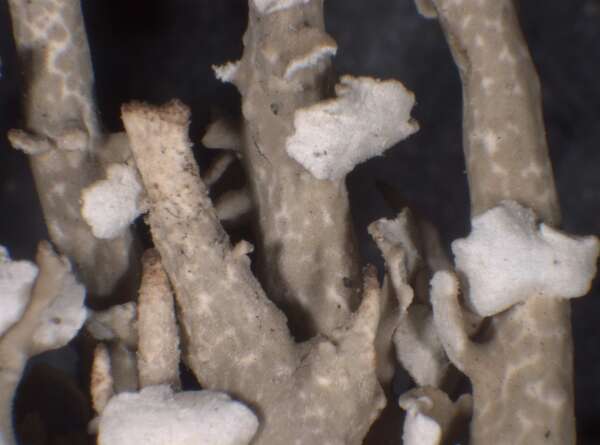
P.L. Nimis; Owner: Department of Life Sciences, University of Trieste
Herbarium: TSB (22)
2002/12/18
detail of podetia with squamules
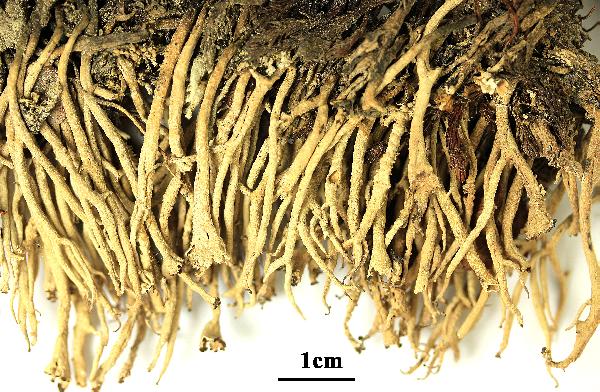
Felix Schumm - CC BY 4.0
[VZ1957], Groenlandia occidentalis. Disko:Lyngmark, ad latera australia
montis Lyngmarksfield, 100-150 m. In angello nivium diu persistentium.
Leg. J. Poelt et H. Ullrich, 256.7.1983, det. J. Poelt. EX A. VEZDA
LICHENES SELECTI EXSICCTI NR. 1957.
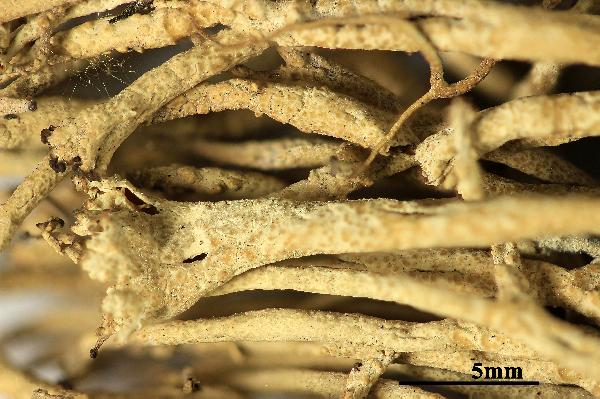
Felix Schumm - CC BY 4.0
[VZ1957], Groenlandia occidentalis. Disko:Lyngmark, ad latera australia
montis Lyngmarksfield, 100-150 m. In angello nivium diu persistentium.
Leg. J. Poelt et H. Ullrich, 256.7.1983, det. J. Poelt. EX A. VEZDA
LICHENES SELECTI EXSICCTI NR. 1957.
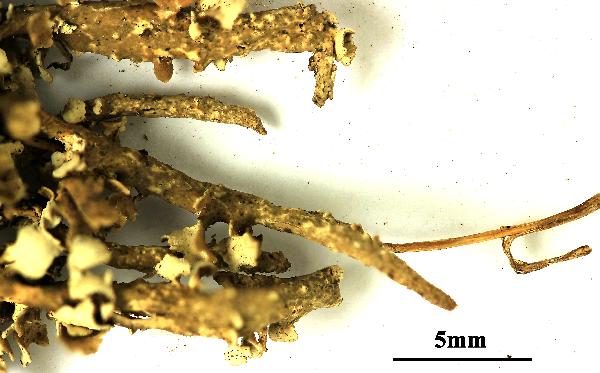
Felix Schumm - CC BY 4.0
[VZ2111], Bohemoslovacia. Slovacia septentrionalis, Carpates, Tatra
Magna: in parte superiore vallis Hlinská dolina, 2080 m. Ad terram
humosam in Saliceto herbaceae. Leg. E. Farkas, Z. Kyselová et A.
Vezda, 25.6.1986. EX A. VEZDA LICHENES SELECTI EXSICCATI NR.
2111.
Felix Schumm - CC BY 4.0
[VZ2111], Bohemoslovacia. Slovacia septentrionalis, Carpates, Tatra
Magna: in parte superiore vallis Hlinská dolina, 2080 m. Ad terram
humosam in Saliceto herbaceae. Leg. E. Farkas, Z. Kyselová et A.
Vezda, 25.6.1986. EX A. VEZDA LICHENES SELECTI EXSICCATI NR.
2111.
Growth form: Fruticose
Substrata: soil, terricolous mosses, and plant debris
Photobiont: green algae other than Trentepohlia
Reproductive strategy: mainly sexual
Commonnes-rarity: (info)
Alpine belt: extremely rare
Subalpine belt: extremely rare
Montane belt: absent
Dry submediterranean belt: absent
Humid submediterranean belt: absent
Padanian area: absent
pH of the substrata:
| 1 | 2 | 3 | 4 | 5 |
Solar irradiation:
| 1 | 2 | 3 | 4 | 5 |
Aridity:
| 1 | 2 | 3 | 4 | 5 |
Eutrophication:
| 1 | 2 | 3 | 4 | 5 |
Poleotolerance:
| 0 | 1 | 2 | 3 |
Altitudinal distribution:
| 1 | 2 | 3 | 4 | 5 | 6 |
Rarity
absent
extremely rare
very rare
rare
rather rare
rather common
common
very common
extremely common
Loading data...
Occurrence data
Predictive map
Einar Timdal http://nhm2.uio.no/lav/web/index.html - CC BY-NC
P.L. Nimis; Owner: Department of Life Sciences, University of Trieste
Herbarium: TSB (22)
2002/12/18
detail of podetia with squamules

Felix Schumm - CC BY 4.0
[VZ1957], Groenlandia occidentalis. Disko:Lyngmark, ad latera australia montis Lyngmarksfield, 100-150 m. In angello nivium diu persistentium. Leg. J. Poelt et H. Ullrich, 256.7.1983, det. J. Poelt. EX A. VEZDA LICHENES SELECTI EXSICCTI NR. 1957.

Felix Schumm - CC BY 4.0
[VZ1957], Groenlandia occidentalis. Disko:Lyngmark, ad latera australia montis Lyngmarksfield, 100-150 m. In angello nivium diu persistentium. Leg. J. Poelt et H. Ullrich, 256.7.1983, det. J. Poelt. EX A. VEZDA LICHENES SELECTI EXSICCTI NR. 1957.

Felix Schumm - CC BY 4.0
[VZ2111], Bohemoslovacia. Slovacia septentrionalis, Carpates, Tatra Magna: in parte superiore vallis Hlinská dolina, 2080 m. Ad terram humosam in Saliceto herbaceae. Leg. E. Farkas, Z. Kyselová et A. Vezda, 25.6.1986. EX A. VEZDA LICHENES SELECTI EXSICCATI NR. 2111.