Thyrea plectopsora A. Massal.
Sched. Crit., 4: 75, n 110, 1856.
Synonyms: Omphalaria camaromorpha A. Massal.?; Thyrea phylliscoides (Nyl.) Zahlbr.
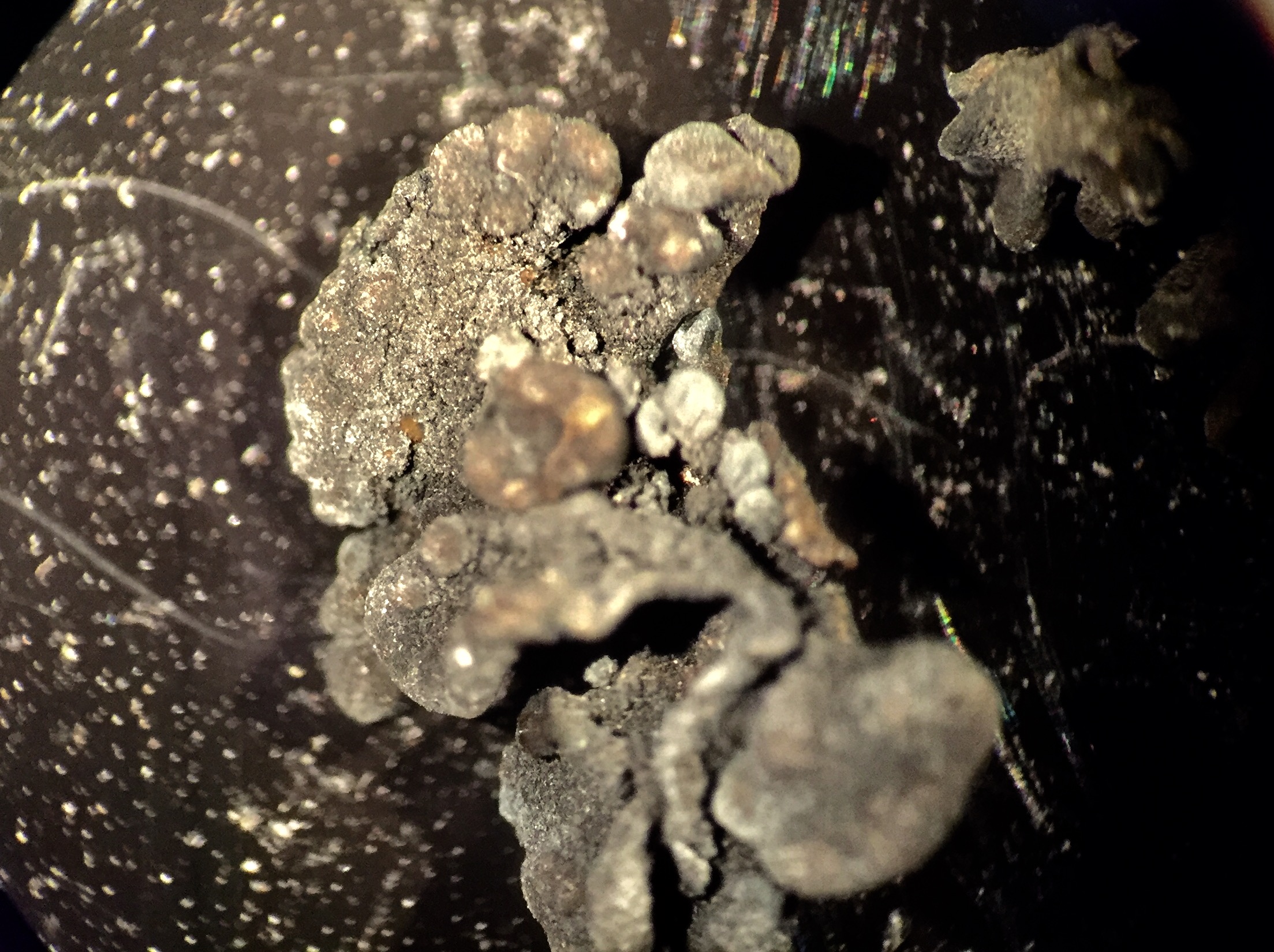
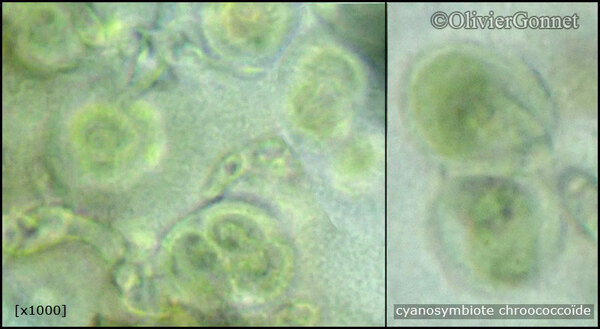
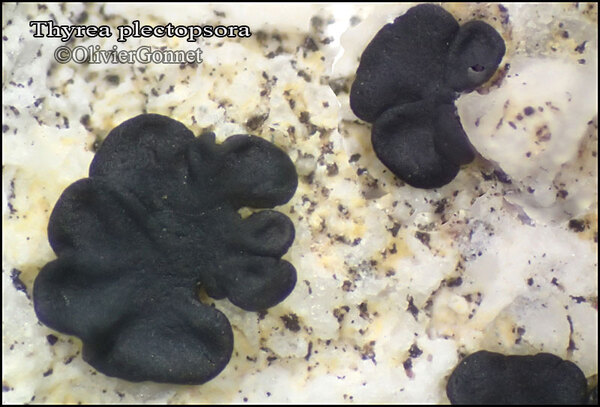
Description: Thallus squamulose to minutely foliose-umbilicate, monophyllous, gelatinous when wet. Squamules orbicular, up to 3 mm across, weakly lobulate, dark olive brown, attached by a central point, the margins clearly reflexed. Thallus ecorticate, photobiont layer to 200 μm thick, with mainly anticlinally oriented hyphae; medulla to 250 μm thick, of irregularly arranged, lax hyphae. Apothecia immersed or semi-immersed, hemiangiocarpic, forming pycnoascocarps from ascogonia beneath pycnidia, with an initially punctiform, later somewhat expanded, concave, reddish brown, up to 0.3 mm wide disc and a thin thalline margin. Proper exciple cupular, 20-25 μm wide; epithecium poorly differentiated; hymenium colourless, to 150 μm thick; paraphyses 2-2.5 μm thick, septate, anastomosing, simple or weakly branched; hypothecium colourless. Asci 8-spored, prototunicate, cylindrical-clavate, thin-walled, with an external, I+ blue cap. Ascospores 1-celled, hyaline, globose to broadly ellipsoid, 9-14 x 6-7 μm. Pycnidia globose, immersed, unilocular. Conidia 1–celled, ellipsoid, 2-3 x 1.5-2 μm. Photobiont cyanobacterial, chroococcoid, with a few cells surrounded by a brownish gelatinous sheath. Spot test: all negative. Chemistry: without lichen substances.
Growth form: Squamulose
Substrata: rocks
Photobiont: cyanobacteria, coccaceous (e.g. Gloeocapsa)
Reproductive strategy: mainly sexual
On otherwise dry surfaces with short periods of water seepage after rain
Commonnes-rarity: (info)
Alpine belt: absent
Subalpine belt: absent
Montane belt: absent
Dry submediterranean belt: very rare
Humid submediterranean belt: very rare
Padanian area: absent
pH of the substrata:
1 2 3 4 5

Solar irradiation:
1 2 3 4 5
Aridity:
1 2 3 4 5
Eutrophication:
1 2 3 4 5
Poleotolerance:
0 1 2 3
Altitudinal distribution:
1 2 3 4 5 6
Rarity
absent
extremely rare
very rare
rare
rather rare
rather common
common
very common
extremely common
Loading data...
Occurrence data
Predictive map
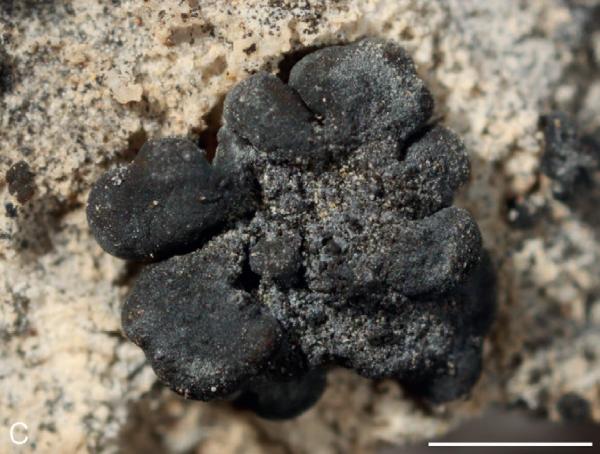
Source: Prieto M., Wedin M., Schultz M. 2024. Phylogeny, evolution and a re-classification of the Lichinomycetes. Studies in Mycology, 109: 595-655. - CC BY-NC-ND
Thyrea plectopsora, squamulose, margin incised forming lobules (Schultz 18162a). Scale bar: 1 mm.
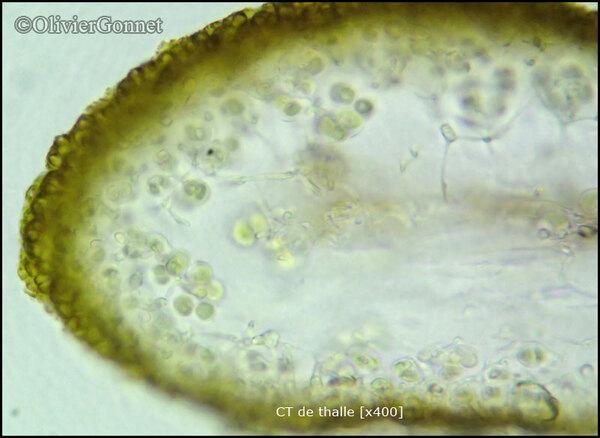
Courtesy Danièle et Olivier Gonnet - Source: https://www.afl-lichenologie.fr/Photos_AFL/Photos_AFL_T/Textes_T2/Thyrea_plectopsora.htm
France, Saut du Moine, 480 m Simiane-la-Rotonde - Alpes-de-Haute-Provence
Courtesy Danièle et Olivier Gonnet - Source: https://www.afl-lichenologie.fr/Photos_AFL/Photos_AFL_T/Textes_T2/Thyrea_plectopsora.htm
France, Saut du Moine, 480 m Simiane-la-Rotonde - Alpes-de-Haute-Provence
Courtesy Danièle et Olivier Gonnet - Source: https://www.afl-lichenologie.fr/Photos_AFL/Photos_AFL_T/Textes_T2/Thyrea_plectopsora.htm
France, Saut du Moine, 480 m Simiane-la-Rotonde - Alpes-de-Haute-Provence
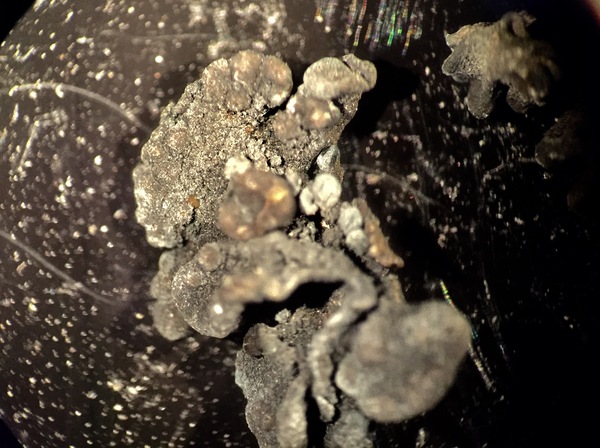
Pier Luigi Nimis
Herbarium: TSB (13427)
Growth form: Squamulose
Substrata: rocks
Photobiont: cyanobacteria, coccaceous (e.g. Gloeocapsa)
Reproductive strategy: mainly sexual
On otherwise dry surfaces with short periods of water seepage after rain
Commonnes-rarity: (info)
Alpine belt: absent
Subalpine belt: absent
Montane belt: absent
Dry submediterranean belt: very rare
Humid submediterranean belt: very rare
Padanian area: absent
pH of the substrata:
| 1 | 2 | 3 | 4 | 5 |
Solar irradiation:
| 1 | 2 | 3 | 4 | 5 |
Aridity:
| 1 | 2 | 3 | 4 | 5 |
Eutrophication:
| 1 | 2 | 3 | 4 | 5 |
Poleotolerance:
| 0 | 1 | 2 | 3 |
Altitudinal distribution:
| 1 | 2 | 3 | 4 | 5 | 6 |
Rarity
absent
extremely rare
very rare
rare
rather rare
rather common
common
very common
extremely common
Loading data...
Occurrence data
Predictive map

Source: Prieto M., Wedin M., Schultz M. 2024. Phylogeny, evolution and a re-classification of the Lichinomycetes. Studies in Mycology, 109: 595-655. - CC BY-NC-ND
Thyrea plectopsora, squamulose, margin incised forming lobules (Schultz 18162a). Scale bar: 1 mm.
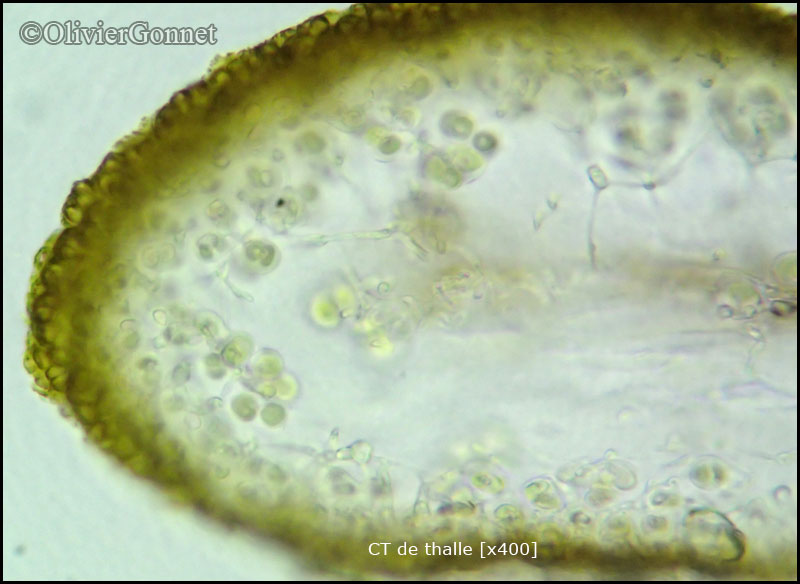
Courtesy Danièle et Olivier Gonnet - Source: https://www.afl-lichenologie.fr/Photos_AFL/Photos_AFL_T/Textes_T2/Thyrea_plectopsora.htm
France, Saut du Moine, 480 m Simiane-la-Rotonde - Alpes-de-Haute-Provence
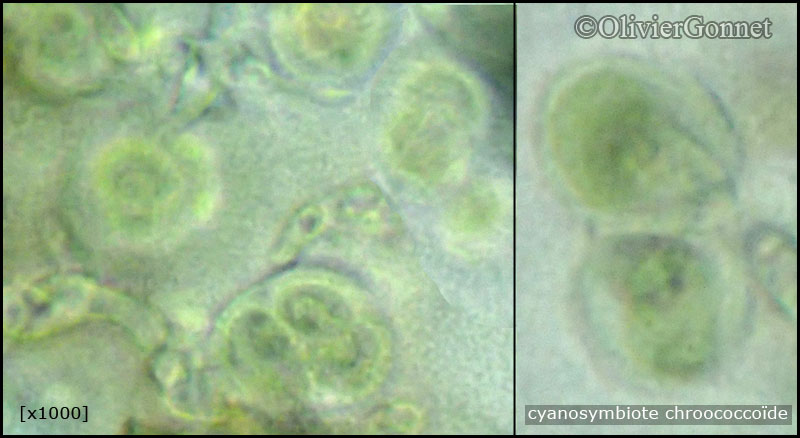
Courtesy Danièle et Olivier Gonnet - Source: https://www.afl-lichenologie.fr/Photos_AFL/Photos_AFL_T/Textes_T2/Thyrea_plectopsora.htm
France, Saut du Moine, 480 m Simiane-la-Rotonde - Alpes-de-Haute-Provence
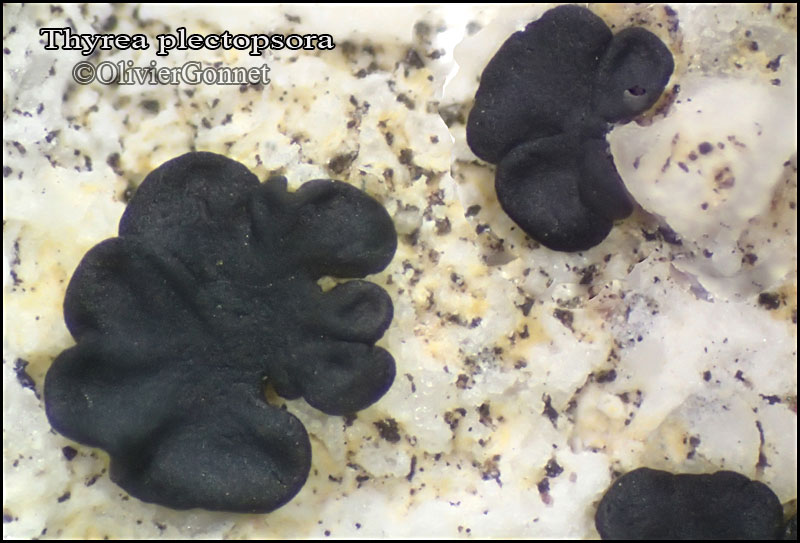
Courtesy Danièle et Olivier Gonnet - Source: https://www.afl-lichenologie.fr/Photos_AFL/Photos_AFL_T/Textes_T2/Thyrea_plectopsora.htm
France, Saut du Moine, 480 m Simiane-la-Rotonde - Alpes-de-Haute-Provence