Amygdalaria panaeola (Ach.) Hertel & Brodo
in Brodo & Hertel, Herzogia, 7: 510, 1987. Basionym: Lecidea panaeola Ach. - K. Vetensk.-Akad. Nya Handl.: 267, 1808.
Synonyms: Huilia panaeola (Ach.) Hertel; Lecidea panaeola var. vulgaris Th. Fr.; Psora panaeola (Ach.) Anzi
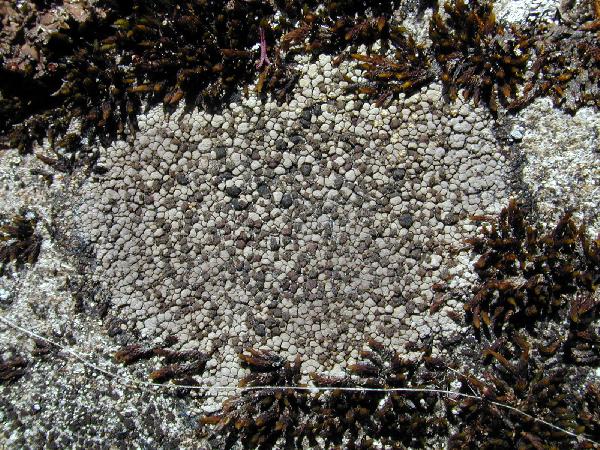
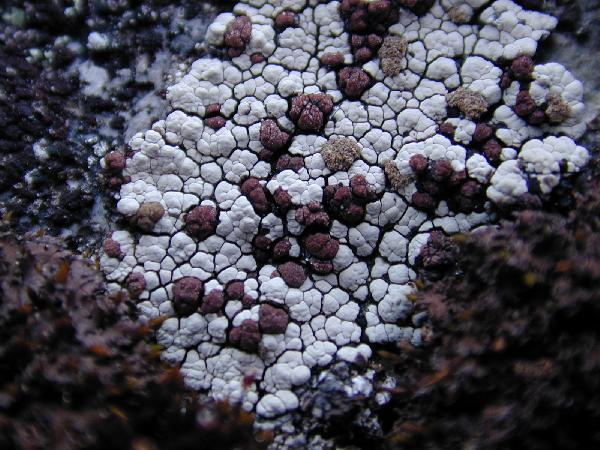
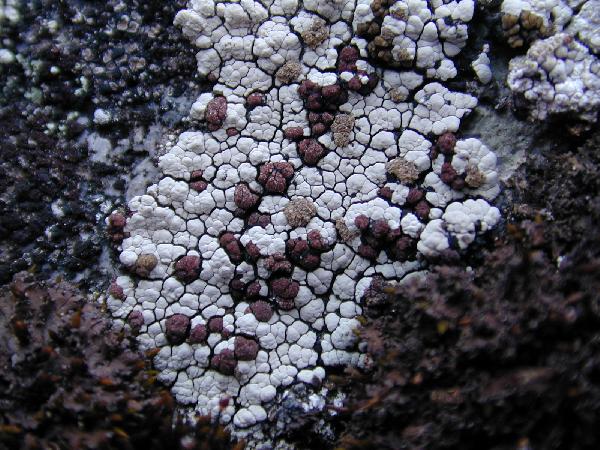
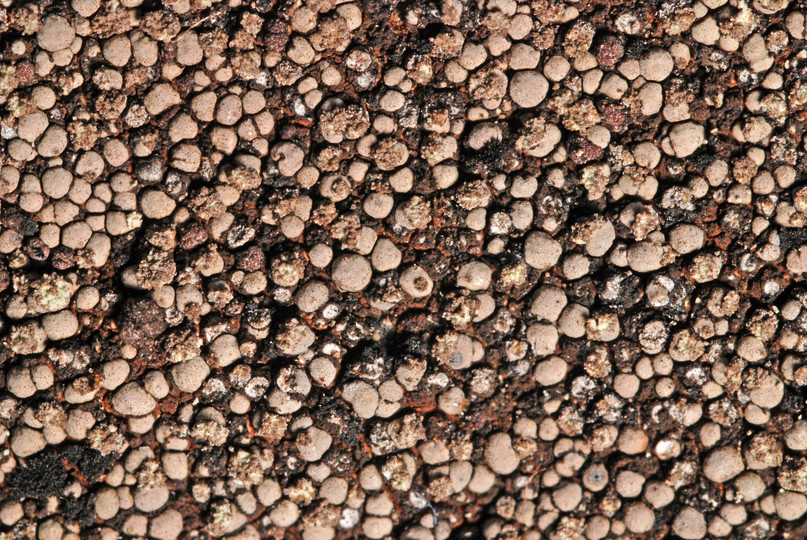
Description: Thallus crustose, episubstratic, up to 2 mm thick, pinkish grey, pale brown or yellowish pink, areolate-verrucose, usually delimited by a dark prothallus, the areoles up to 1.2 mm wide, convex, sometimes bullate, round to angular by mutual compression (especially in the central parts of thallus), often sorediate along the margins. Cephalodia arising mainly between the areoles, pinkish or reddish brown, 0.5-1.4 mm wide, with a tuberculate-botryoid surface. Medulla white, I-. Apothecia rare, arising between the areoles and usually not protruding, lecideine, up to 1 mm across, with a mostly flat, black, epruinose, roughened disc and a thin, brownish black, persistent or finally excluded proper margin. Proper exciple poorly developed, brown, of conglutinated, radially arranged hyphae; epithecium brownish black, covered in a granular, black layer; hymenium colourless, up to 160 μm high, I+ blue; paraphyses coherent, slender, branched and anastomosing, not or only slightly thickened at tips, often moniliform in upper part; hypothecium dark brown. Asci 8-spored, elongate-clavate, with a thin, outer amyloid layer and a thickened tholus penetrated by a pore, the sides of which stain I/KI+ deep blue, Porpidia-type. Ascospores 1-celled, hyaline, ellipsoid, 22-27 x 9-15 μm, when young with a thin perispore. Pycnidia black, immersed. Conidia short-acicular, straight, 7-10 μm long. Photobiont chlorococcoid; cephalodia with Stigonema. Spot tests: cortex K-, C+ red, KC+ red, P-; medulla K-, C-, KC-, P-. Chemistry: cortex with gyrophoric acid and traces of lecanoric acid.
Growth form: Crustose
Substrata: rocks
Photobiont: green algae other than Trentepohlia (primary); cyanobacteria, filamentous (e.g. Nostoc, Scytonema) (secundary, e.g. in cephalodia)
Reproductive strategy: mainly asexual, by soredia, or soredia-like structures (e.g. blastidia)
Commonnes-rarity: (info)
Alpine belt: very rare
Subalpine belt: extremely rare
Montane belt: extremely rare
Dry submediterranean belt: absent
Humid submediterranean belt: absent
Padanian area: absent
pH of the substrata:
1 2 3 4 5

Solar irradiation:
1 2 3 4 5
Aridity:
1 2 3 4 5
Eutrophication:
1 2 3 4 5
Poleotolerance:
0 1 2 3
Altitudinal distribution:
1 2 3 4 5 6
Rarity
absent
extremely rare
very rare
rare
rather rare
rather common
common
very common
extremely common
Loading data...
Occurrence data
Predictive map

Leif Stridvall - Source: http://www.stridvall.se/la/galleries.php (Courtesy: Anita Stridvall)

Source: http://www.stridvall.se/la/galleries.php

Leif Stridvall - Source: http://www.stridvall.se/lichens/gallery/
Courtesy: Anita Stridvall

Pier Luigi Nimis - CC BY-SA 4.0
TSB 44018

Pier Luigi Nimis - CC BY-SA 4.0
TSB 44018

Pier Luigi Nimis - CC BY-SA 4.0
TSB 44018

Pier Luigi Nimis - CC BY-SA 4.0
TSB 44019

Pier Luigi Nimis - CC BY-SA 4.0
TSB 44019
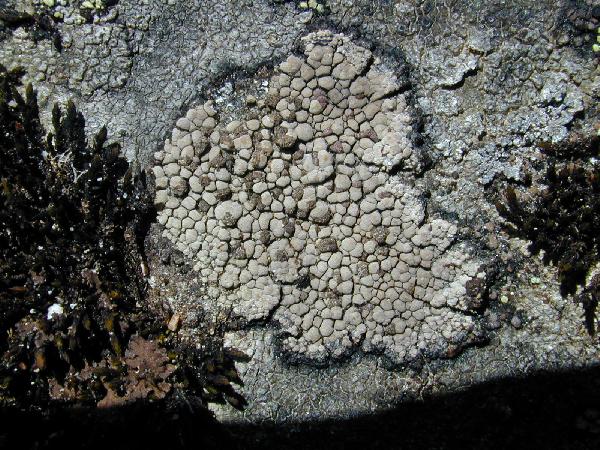
Wolfgang von Brackel - CC BY 4.0
Greenland, Qanassiassat, ., .
Wolfgang von Brackel - CC BY 4.0
Greenland, Qanassiassat, ., .
Wolfgang von Brackel - CC BY 4.0
Greenland, Qanassiassat, ., .
Wolfgang von Brackel - CC BY 4.0
Greenland, Suuluaqqap, ., .
Growth form: Crustose
Substrata: rocks
Photobiont: green algae other than Trentepohlia (primary); cyanobacteria, filamentous (e.g. Nostoc, Scytonema) (secundary, e.g. in cephalodia)
Reproductive strategy: mainly asexual, by soredia, or soredia-like structures (e.g. blastidia)
Commonnes-rarity: (info)
Alpine belt: very rare
Subalpine belt: extremely rare
Montane belt: extremely rare
Dry submediterranean belt: absent
Humid submediterranean belt: absent
Padanian area: absent
pH of the substrata:
| 1 | 2 | 3 | 4 | 5 |
Solar irradiation:
| 1 | 2 | 3 | 4 | 5 |
Aridity:
| 1 | 2 | 3 | 4 | 5 |
Eutrophication:
| 1 | 2 | 3 | 4 | 5 |
Poleotolerance:
| 0 | 1 | 2 | 3 |
Altitudinal distribution:
| 1 | 2 | 3 | 4 | 5 | 6 |
Rarity
absent
extremely rare
very rare
rare
rather rare
rather common
common
very common
extremely common
Loading data...
Occurrence data
Predictive map

Leif Stridvall - Source: http://www.stridvall.se/la/galleries.php (Courtesy: Anita Stridvall)
Source: http://www.stridvall.se/la/galleries.php
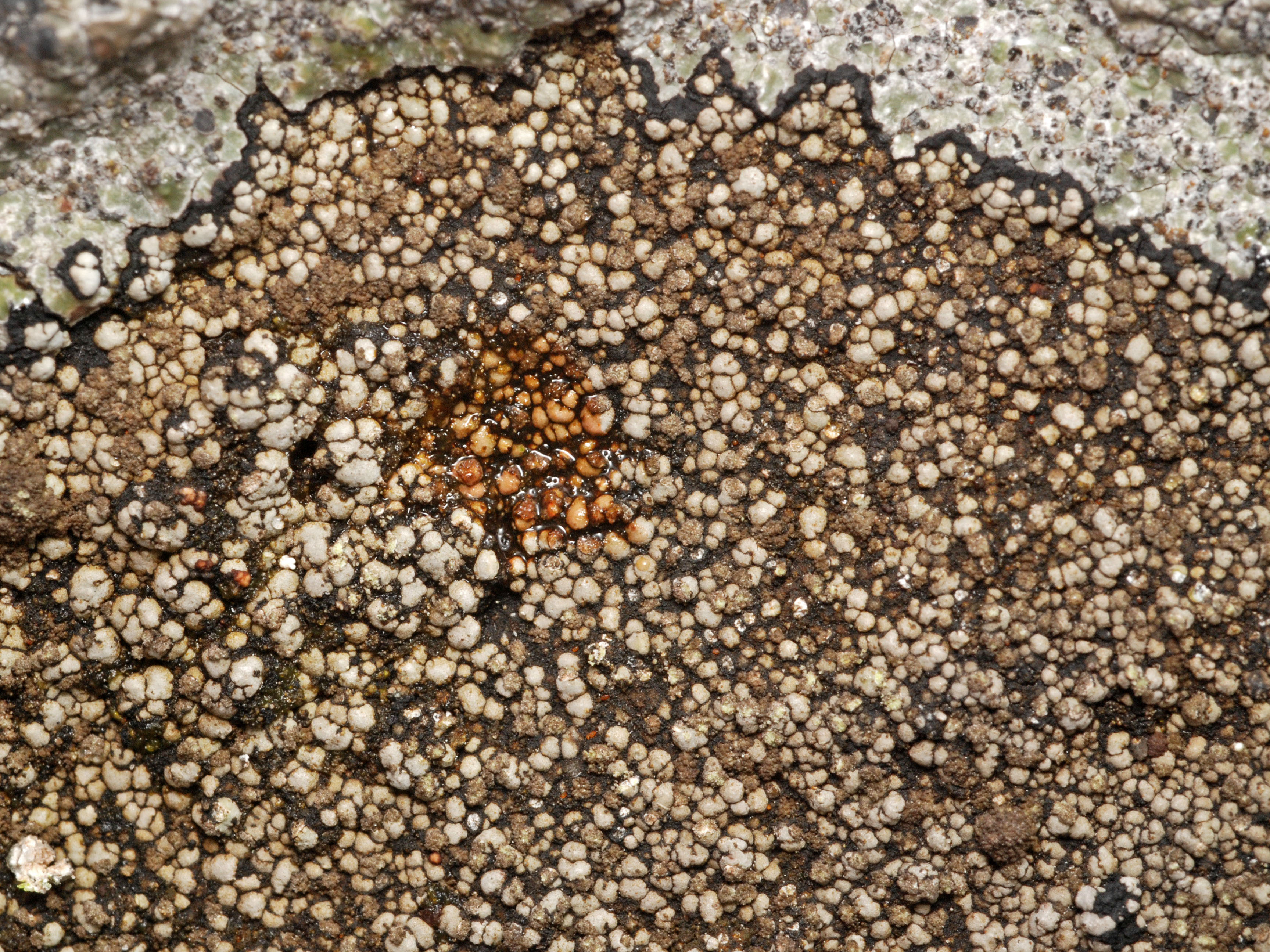
Leif Stridvall - Source: http://www.stridvall.se/lichens/gallery/
Courtesy: Anita Stridvall
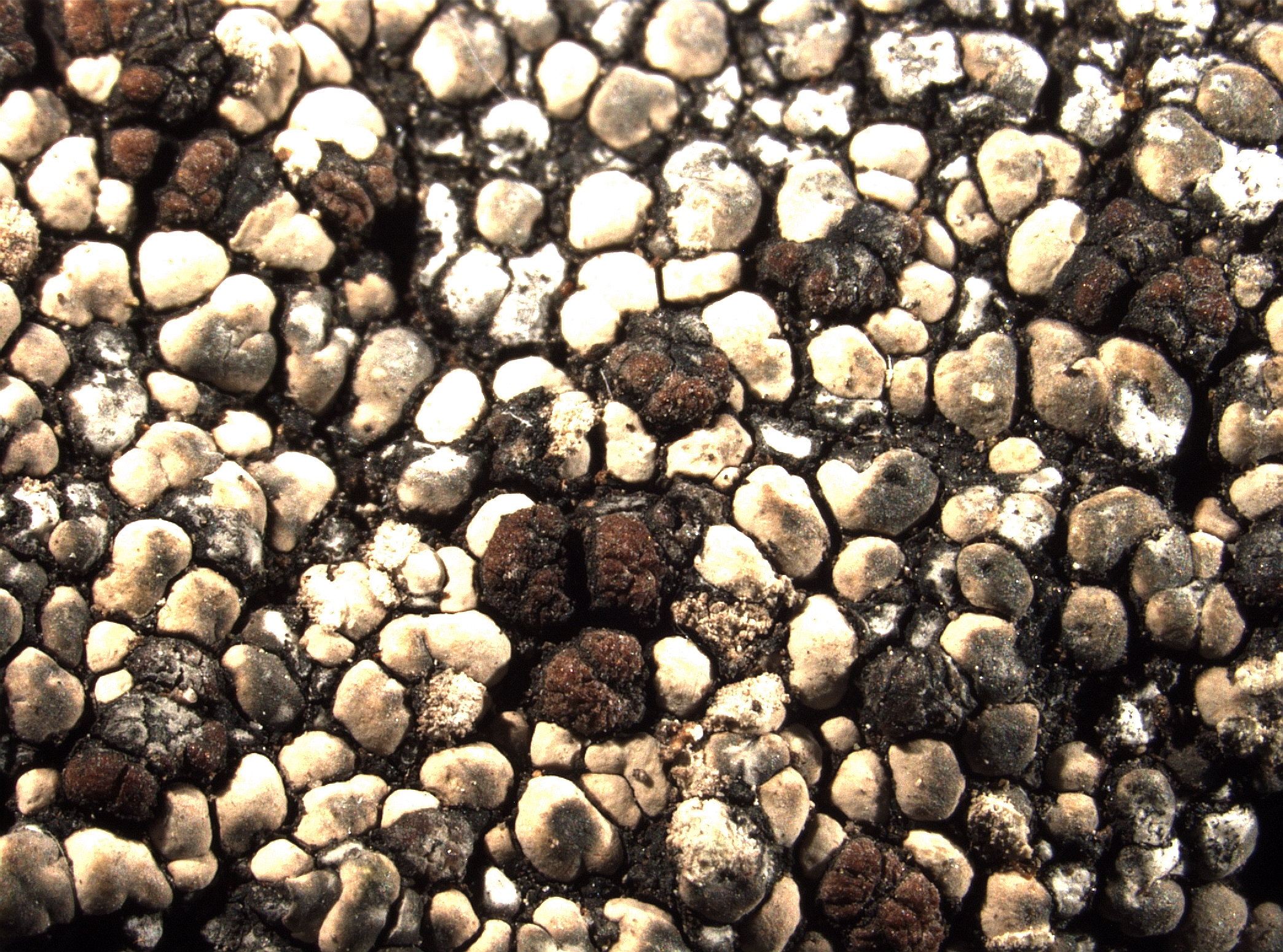
Pier Luigi Nimis - CC BY-SA 4.0
TSB 44018
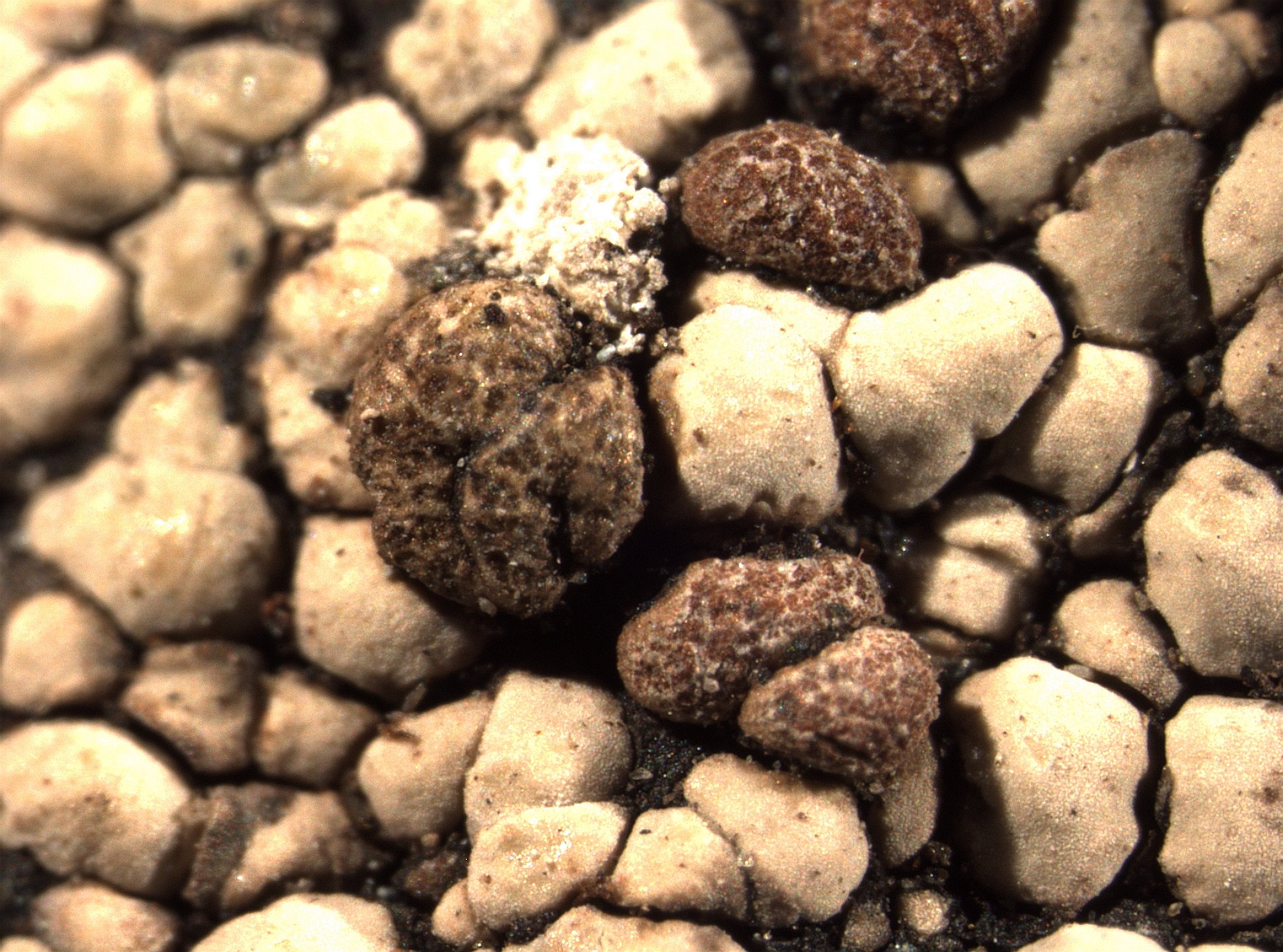
Pier Luigi Nimis - CC BY-SA 4.0
TSB 44018
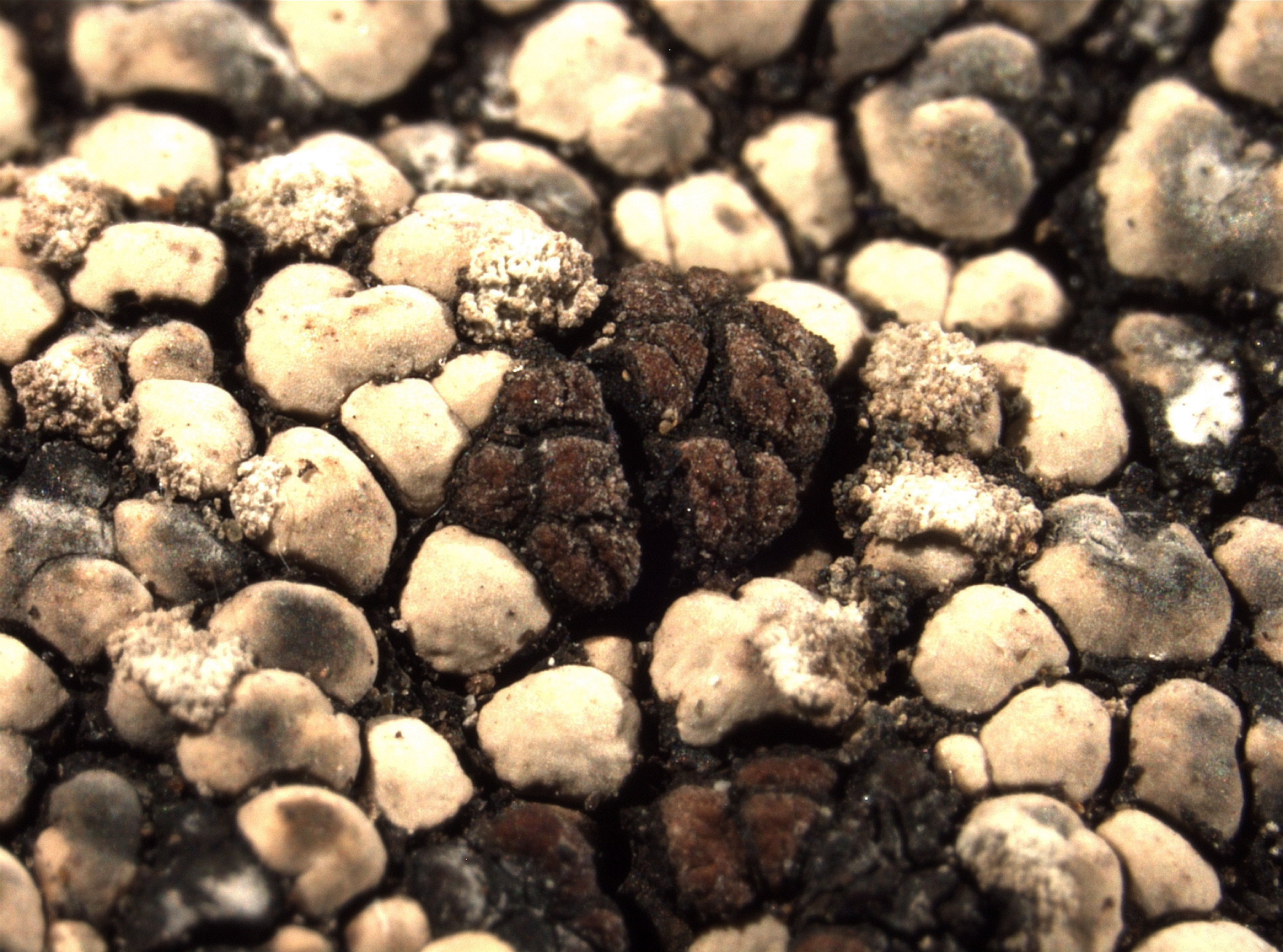
Pier Luigi Nimis - CC BY-SA 4.0
TSB 44018
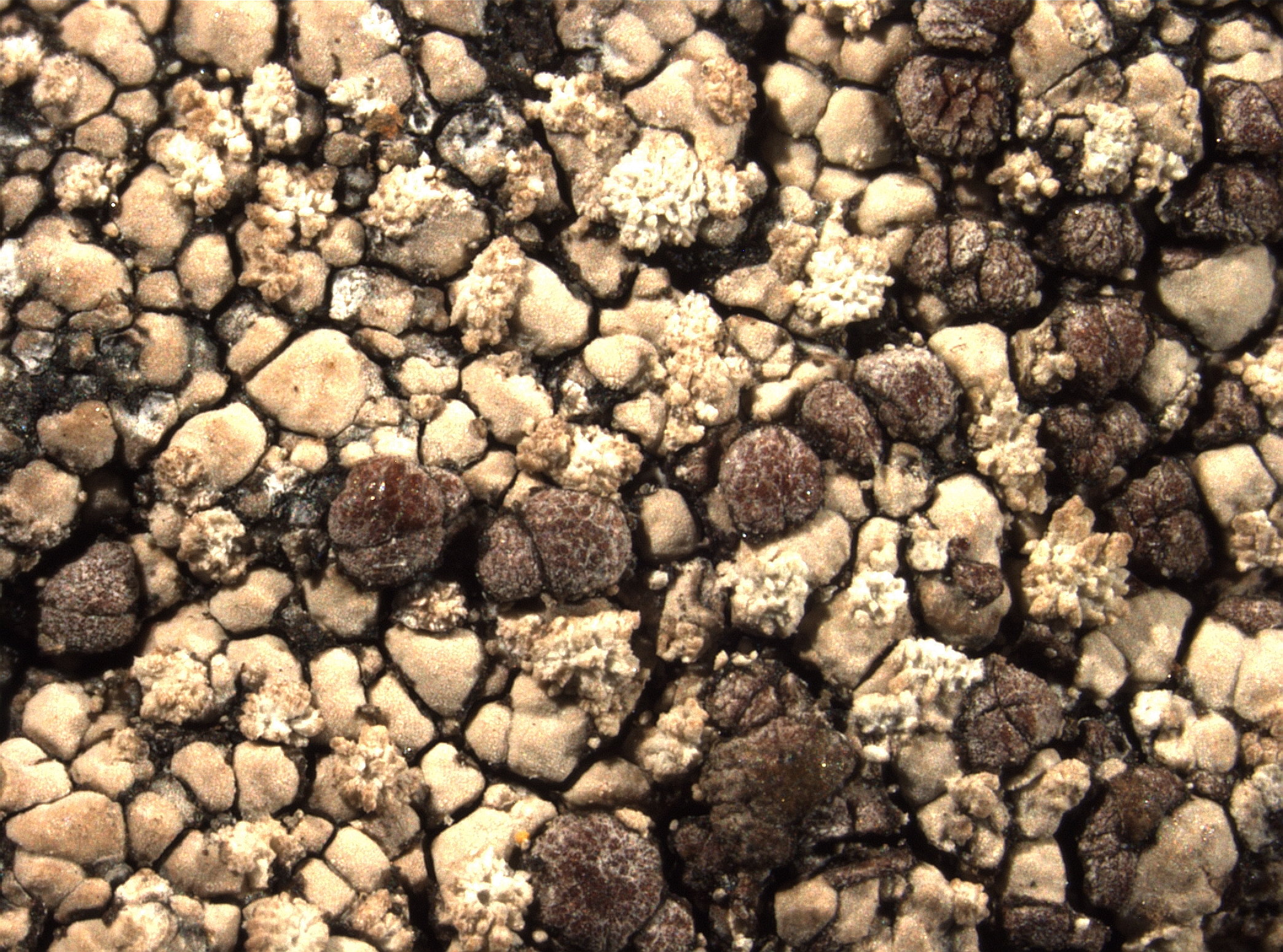
Pier Luigi Nimis - CC BY-SA 4.0
TSB 44019
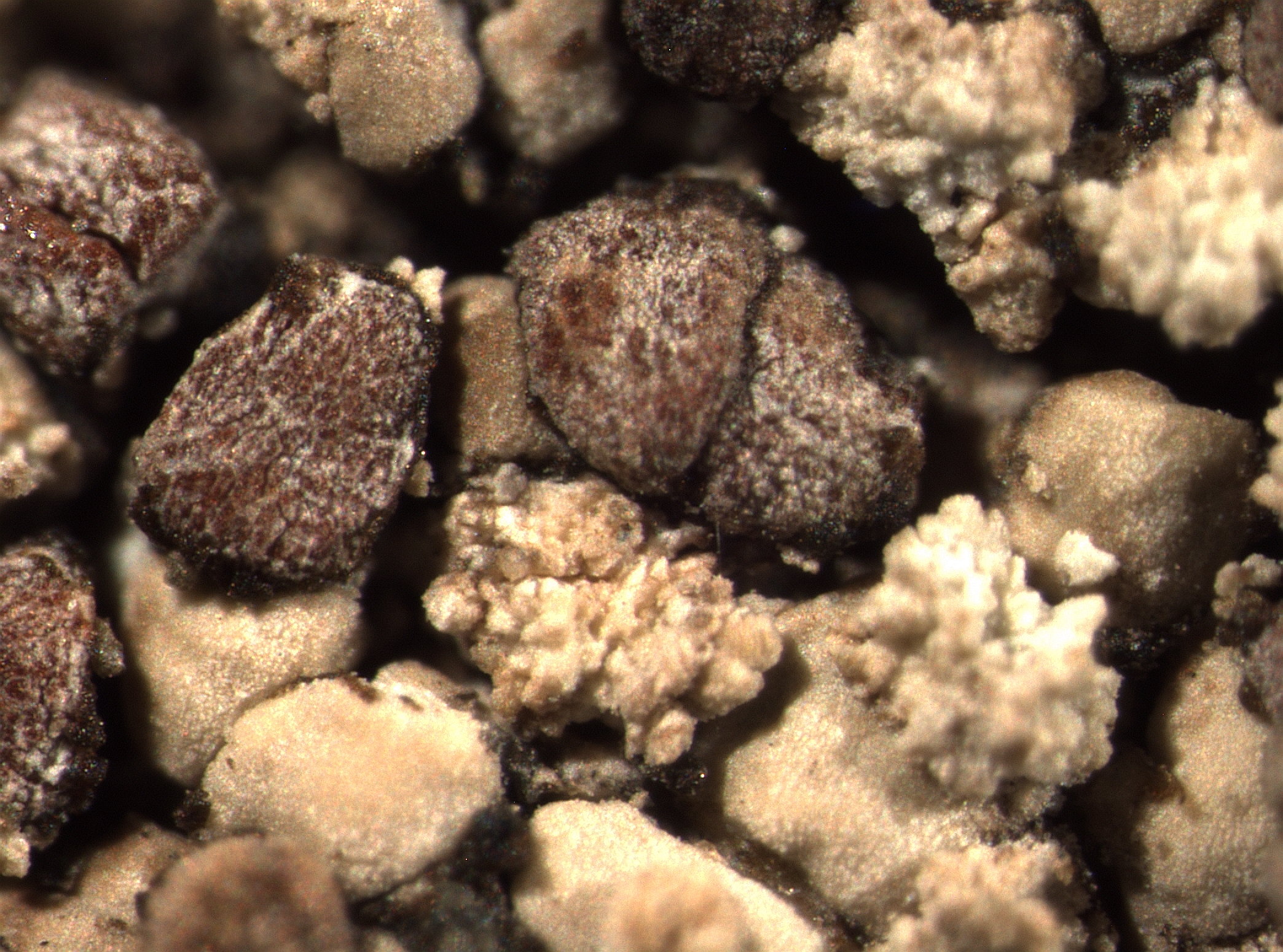
Pier Luigi Nimis - CC BY-SA 4.0
TSB 44019

Wolfgang von Brackel - CC BY 4.0
Greenland, Qanassiassat, ., .

Wolfgang von Brackel - CC BY 4.0
Greenland, Qanassiassat, ., .

Wolfgang von Brackel - CC BY 4.0
Greenland, Qanassiassat, ., .