Acarospora cinerascens J. Steiner
in Arnold, Lich. Exs.: nr. 1500, 1890.
Synonyms: Acarospora alboatra H. Magn.
Description: Thallus crustose, episubstratic, areolate-subsquamulose, densely white-pruinose, the areoles 0.5-1(-2) mm wide, 0.3-0.6 mm thick, at first flat, then convex and fissured or reticulately grooved, dispersed or usually contiguous and separated by deep fissures, reddish brown, but almost always appearing white due to the thick layer of pruina, the margins most often dark. Epicortex to 30 µm thick, with small crystals dissolving in K; cortex 20-70 µm thick, brown in upper part, colourless in lower part, the cells mostly 3-4 µm wide; algal layer continuous, 100-150 µm thick; medulla white, to 0.4 µm thick, I-. Apothecia lecanorine, immersed, 0.3-1 mm across, with a black to brown-black, sometimes slightly pruinose disc and a thick, often radially fissured thalline margin. Proper exciple prosoplectenchymatous, widening around the disc to c. 30-50(-100) µm, sometimes distinct as a blackish ring around the disc, I-; epithecium brown, c. 10 µm high; hymenium colourless, 120-150 µm high, the hymenial gel hemiamyloid, I+ light blue fading to light red; paraphyses c. 1 µm thick at mid-level, the apical cells hardly swollen; subhymenium 30-50 µm high, I+ blue; hypothecium narrow, usually 10 µm high. Asci 100-200-spored, clavate, the apical dome K/I-, 100-130 x 20-25 µm. Ascospores 1-celled, hyaline, ellipsoid, 6-9(-12) x 2.5-3.5(-4) µm. Pycnidia immersed, dark. Conidia simple, ellipsoid, c. 2 x 1.5 µm. Photobiont chlorococcoid. Spot tests: cortex and medulla K-, C-, KC-, P-, UV-. Chemistry: without lichen substances.
Growth form: Crustose
Substrata: rocks
Photobiont: green algae other than Trentepohlia
Reproductive strategy: mainly sexual
Subcontinental: restricted to areas with a dry-subcontinental climate (e.g. dry Alpine valleys, parts of Mediterranean Italy)
Commonnes-rarity: (info)
Alpine belt: absent
Subalpine belt: very rare
Montane belt: very rare
Dry submediterranean belt: extremely rare
Humid submediterranean belt: absent
Padanian area: absent
pH of the substrata:
1 2 3 4 5

Solar irradiation:
1 2 3 4 5
Aridity:
1 2 3 4 5
Eutrophication:
1 2 3 4 5
Poleotolerance:
0 1 2 3
Altitudinal distribution:
1 2 3 4 5 6
Rarity
absent
extremely rare
very rare
rare
rather rare
rather common
common
very common
extremely common
Loading data...
Occurrence data
Predictive map

From: Knudsen et al., Herziogia, 28, 2: 690-696, 2015 (Buschardt 420 - B) Scale: 0.5 mm

Modified from: https://gzu.jacq.org/GZU000277811
GZU000277811 - Leg. J. Poelt -1970-09-12
Location Italy / Trentino-Alto Adige
Label Südtirol, Vintschgau: S-exponierte Felshänge E am Eingang in das Schlanderaunertal bei Schlanders ; Alt. 750 m - 800 m
Habitat S-exponierte, steile Felshänge
Growth form: Crustose
Substrata: rocks
Photobiont: green algae other than Trentepohlia
Reproductive strategy: mainly sexual
Subcontinental: restricted to areas with a dry-subcontinental climate (e.g. dry Alpine valleys, parts of Mediterranean Italy)
Commonnes-rarity: (info)
Alpine belt: absent
Subalpine belt: very rare
Montane belt: very rare
Dry submediterranean belt: extremely rare
Humid submediterranean belt: absent
Padanian area: absent
pH of the substrata:
| 1 | 2 | 3 | 4 | 5 |
Solar irradiation:
| 1 | 2 | 3 | 4 | 5 |
Aridity:
| 1 | 2 | 3 | 4 | 5 |
Eutrophication:
| 1 | 2 | 3 | 4 | 5 |
Poleotolerance:
| 0 | 1 | 2 | 3 |
Altitudinal distribution:
| 1 | 2 | 3 | 4 | 5 | 6 |
Rarity
absent
extremely rare
very rare
rare
rather rare
rather common
common
very common
extremely common
Loading data...
Occurrence data
Predictive map
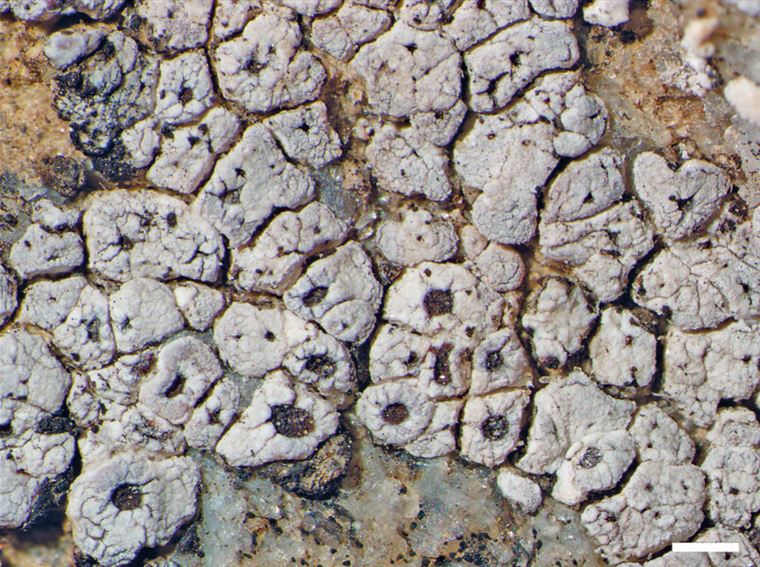
From: Knudsen et al., Herziogia, 28, 2: 690-696, 2015 (Buschardt 420 - B) Scale: 0.5 mm