Diromma dirinellum (Nyl.) Ertz & Tehler
in Ertz & al., Fungal Divers., 70: 41, 2014. Basionym: Platygrapha dirinella Nyl. - Mém. Soc. Sc. Nat. Cherbourg, 4: 95, 1856.
Synonyms: Lecania diplotommoides Bagl.; Platygrapha diplotommoides (Bagl.) Jatta; Schismatomma diplotommoides (Bagl.) Samp.; Schismatomma diplotommoides var. crenulatum B. de Lesd.; Schismatomma dirinellum (Nyl.) Zahlbr.
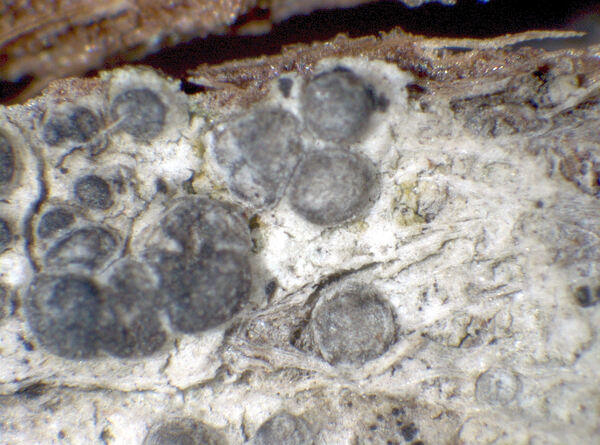
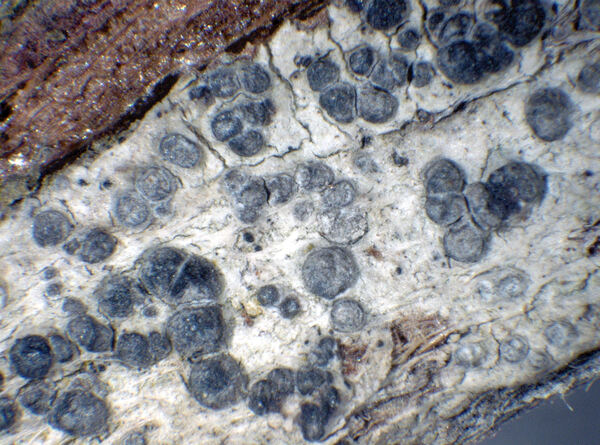
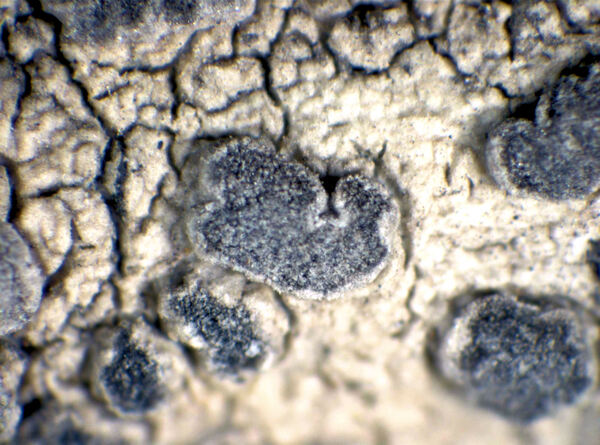
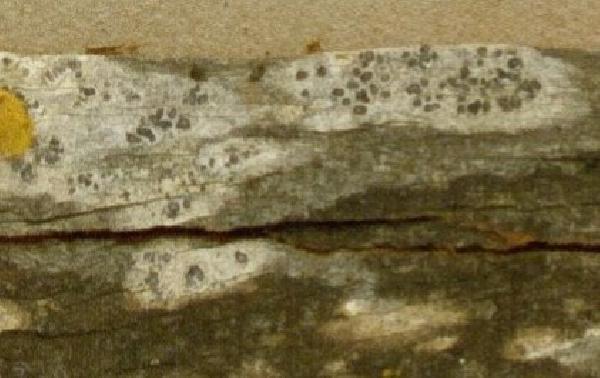
Description: Thallus crustose, whitish grey, at first poorly evident, then rimose-areolate, corticate, forming small patches on the thalli of Dirina ceratoniae. Apothecia 0.1-0.4(-0.6) mm across, round, oblong or irregular in outline, immersed to semi-immersed, sometimes confluent, with a dark brown to brown-black, often white-pruinose disc, a poorly evident proper margin, and a corticate, finally sometimes excluded thalline margin level with disc. Proper exciple very thin, inconspicuous; epithecium pale brown to greenish brown; hymenium colourless, I+ reddish; paraphysoids coherent, simple or sparingly branched in upper part, slender, c. 1.5 µm thick, the apical cells up to 3 µm wide; hypothecium colourless to pale brown, I+ blue. Asci 8-spored, clavate, bitunicate, the apex thickened with a small internal K/I+ blue ring. Ascospores 3-septate, hyaline, fusiform to ellipsoid with rounded ends, slightly curved, (18-)20-31 x 4-5.5 µm, without a perispore. Photobiont trentepohlioid. Spot tests: thallus K-, C-, KC-, P-. Chemistry: thallus with roccellic acid.
Growth form: Crustose
Substrata: bark
Photobiont: Trentepohlia
Reproductive strategy: mainly sexual
paras Dirina ceratoniae
Taxon bound to maritime-coastal situations
Commonnes-rarity: (info)
Alpine belt: absent
Subalpine belt: absent
Montane belt: absent
Dry submediterranean belt: absent
Humid submediterranean belt: absent
Padanian area: absent
pH of the substrata:
1 2 3 4 5

Solar irradiation:
1 2 3 4 5
Aridity:
1 2 3 4 5
Eutrophication:
1 2 3 4 5
Poleotolerance:
0 1 2 3
Altitudinal distribution:
1 2 3 4 5 6
Rarity
absent
extremely rare
very rare
rare
rather rare
rather common
common
very common
extremely common
Loading data...
Occurrence data
Predictive map
P.L. Nimis CC BY-SA 4.0
TSB 38349
P.L. Nimis CC BY-SA 4.0
TSB 38349
P.L. Nimis CC BY-SA 4.0
TSB 16051
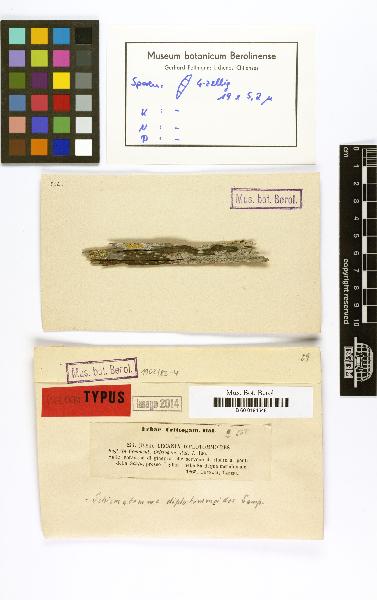
Source: https://pictures.bgbm.org/iiif/3/B!60!01!94!54!B_60_0194548.jpg/full/2048,/0/default.jpg
As Lecania diplotommoides - Berlin-Dahlem Botanical Garden and Botanical Museum, Germany - CC BY-SA.
Source: https://pictures.bgbm.org/iiif/3/B!60!01!94!54!B_60_0194548.jpg/full/2048,/0/default.jpg
As Lecania diplotommoides - Berlin-Dahlem Botanical Garden and Botanical Museum, Germany - CC BY-SA.
Growth form: Crustose
Substrata: bark
Photobiont: Trentepohlia
Reproductive strategy: mainly sexual
paras Dirina ceratoniae
Taxon bound to maritime-coastal situations
Commonnes-rarity: (info)
Alpine belt: absent
Subalpine belt: absent
Montane belt: absent
Dry submediterranean belt: absent
Humid submediterranean belt: absent
Padanian area: absent
pH of the substrata:
| 1 | 2 | 3 | 4 | 5 |
Solar irradiation:
| 1 | 2 | 3 | 4 | 5 |
Aridity:
| 1 | 2 | 3 | 4 | 5 |
Eutrophication:
| 1 | 2 | 3 | 4 | 5 |
Poleotolerance:
| 0 | 1 | 2 | 3 |
Altitudinal distribution:
| 1 | 2 | 3 | 4 | 5 | 6 |
Rarity
absent
extremely rare
very rare
rare
rather rare
rather common
common
very common
extremely common
Loading data...
Occurrence data
Predictive map

P.L. Nimis CC BY-SA 4.0
TSB 38349
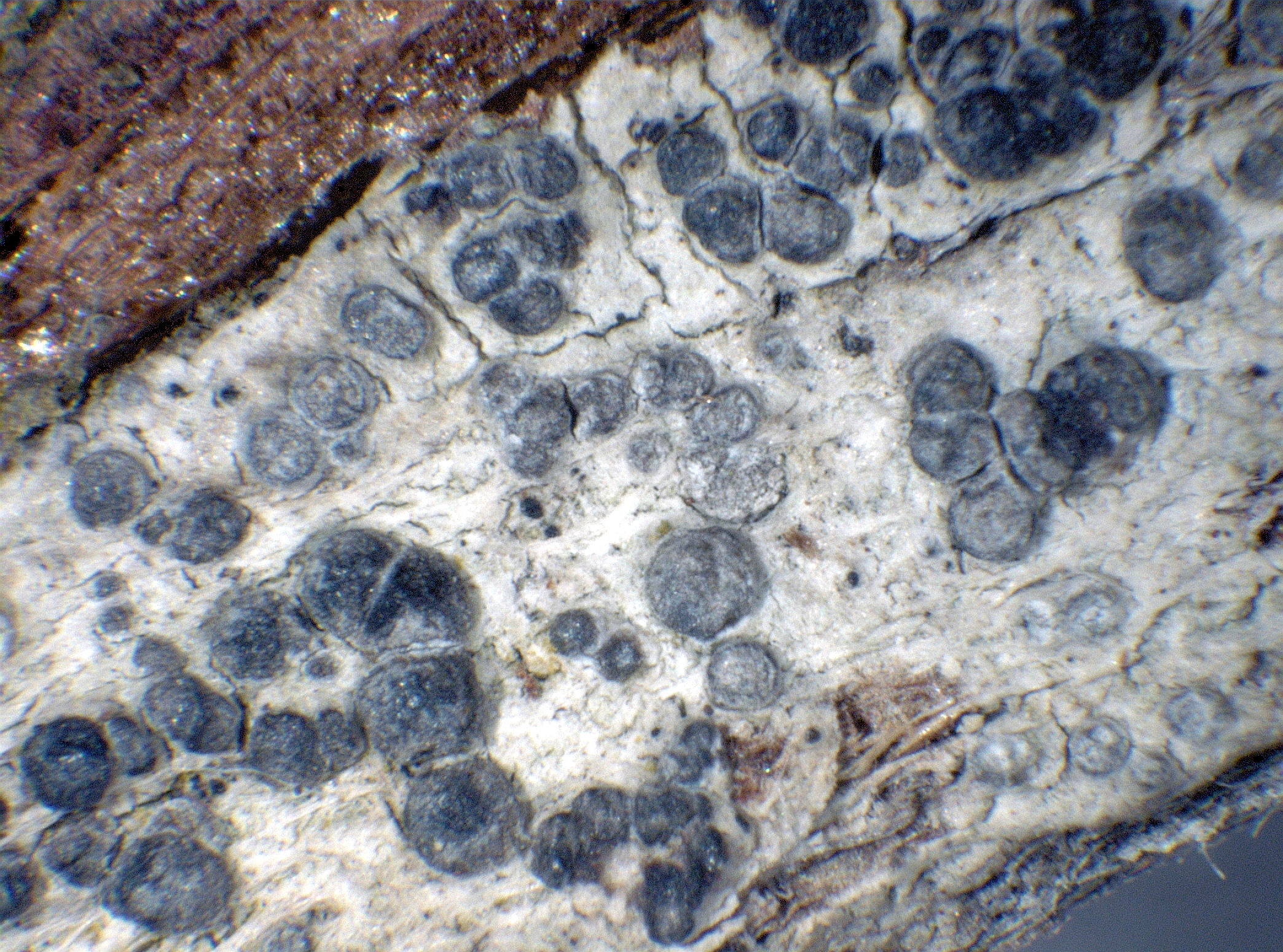
P.L. Nimis CC BY-SA 4.0
TSB 38349

P.L. Nimis CC BY-SA 4.0
TSB 16051

Source: https://pictures.bgbm.org/iiif/3/B!60!01!94!54!B_60_0194548.jpg/full/2048,/0/default.jpg
As Lecania diplotommoides - Berlin-Dahlem Botanical Garden and Botanical Museum, Germany - CC BY-SA.