Frutidella furfuracea (Anzi) M. Westb. & M. Svensson
Mycokeys, 25: 64, 2017. Basionym: Biatora furfuracea Anzi - Comm. Soc. Crittog. Ital. 2: 13, 1864.
Synonyms: Biatora amaurospoda Anzi; Biatora pullata Norman; Frutidella pullata (Norman) Schmull; Lecidea anziana Zahlbr.; Lecidea furfuracea (Anzi) Jatta non Pers.; Lecidea ostrogothensis Nyl.; Lecidea perobscurans Nyl.; Lecidea pullata (Norman) Th. Fr.
Description: Thallus crustose, endo- to episubstratic in non-sorediate parts, continuous to more or less distinctly areolate, forming regular or irregular, up to 10 cm wide patches, usually delimited by a dark, bluish to brown prothallus, the blue pigment N+ red. Areoles 0.1-0.3 mm wide, convex, green to pale brown, soon bursting apically into minute, irregularly punctiform, 0.1(-0.3) mm wide, mostly flat soralia which rarely coalesce into a subleprose crust; soredia farinose, up to 20-30 μm in diam, the external ones brownish, the internal ones pale greenish. Apothecia not always present, biatorine, up to 0.6 mm across, the disc flat to strongly convex, blackish but often faintly pruinose and appearing bluish grey, lead-grey or grey-black, rarely with a brownish hue, the proper margin soon excluded. Proper exciple more or less colourless, of radiating hyphae; epithecium pale olive-green to greenish brown; hymenium colourless to bluish green in upper part; paraphyses strongly coherent, sparingly branched and anastomosing; hypothecium pale olive-brown. Asci 8-spored, clavate, the K/I+ blue tholus penetrated by a faintly amyloid apical cushion with parallel or diverging flanks, the wall K/I-, surrounded by a K/I+ blue outer layer, Lecanora-type. Ascospores 1-celled, hyaline, ellipsoid, 9-17 x 4-7.5 µm. Photobiont chlorococcoid. Spot tests: thallus and soralia K- (or soralia K+ very pale yellow), C-, KC-, P-, UV+ white. Chemistry: sphaerophorin (major), isosphaeric acid (traces).
Growth form: Crustose
Photobiont: green algae other than Trentepohlia
Reproductive strategy: mainly asexual, by soredia, or soredia-like structures (e.g. blastidia)
Commonnes-rarity: (info)
Alpine belt: absent
Subalpine belt: rather common
Montane belt: rather rare
Dry submediterranean belt: absent
Humid submediterranean belt: absent
Padanian area: absent
pH of the substrata:
1 2 3 4 5

Solar irradiation:
1 2 3 4 5
Aridity:
1 2 3 4 5
Eutrophication:
1 2 3 4 5
Poleotolerance:
0 1 2 3
Altitudinal distribution:
1 2 3 4 5 6
Rarity
absent
extremely rare
very rare
rare
rather rare
rather common
common
very common
extremely common
Loading data...
Occurrence data
Predictive map
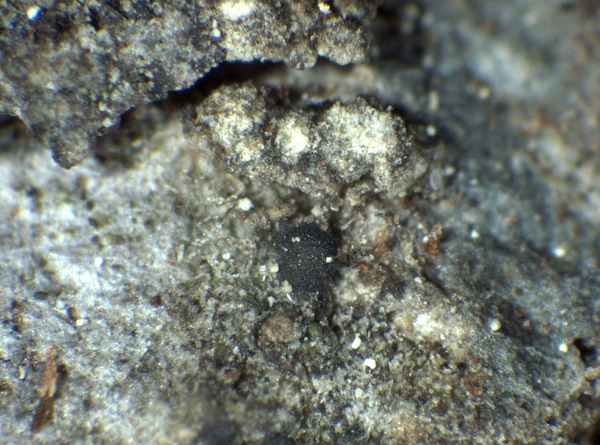
P.L.Nimis; Owner: Department of Life Sciences, University of Trieste
Herbarium: TSB (36847)
2008.02.25
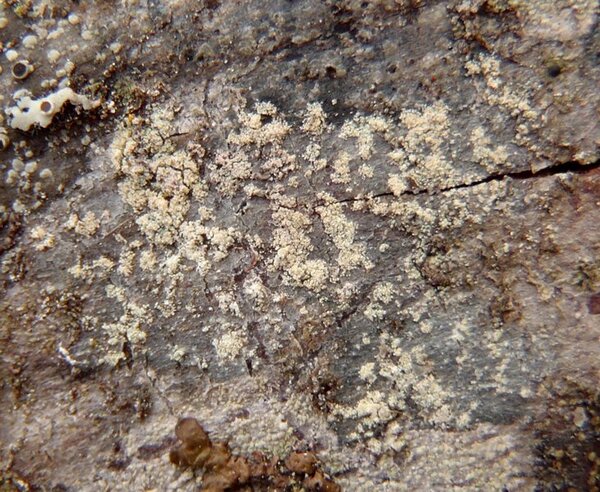
Curtis Randall Björk – CC BY-SA 4.0
British Columbia, Clearwater Valley Date: 2012-04-04 Corticolous on trunk of Alnus incana in garden
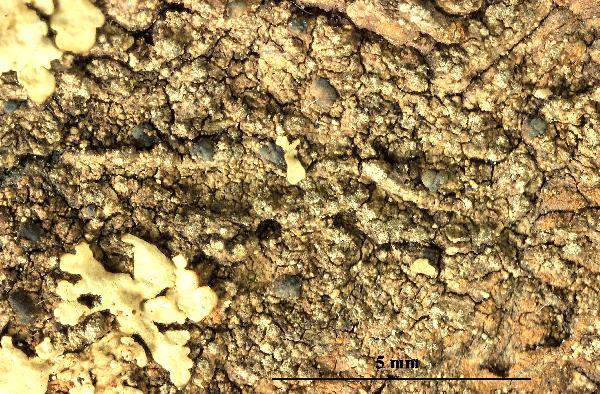
Felix Schumm - CC BY 4.0
[VZ2057], Bohemoslovacia. Slovacia, Carpati, montes Tatra Minor, in
pede merid. montis umbier, in valle prope Trangoska, 1300 m. Ad
corticem Aceris pseudoplatani. Leg. E. Farkas et A. Vezda, 28.5.1985.
Ex A. Vezda Lichenes Selecti Exsiccati Nr. 2057. - As Lecidea pullata
Growth form: Crustose
Photobiont: green algae other than Trentepohlia
Reproductive strategy: mainly asexual, by soredia, or soredia-like structures (e.g. blastidia)
Commonnes-rarity: (info)
Alpine belt: absent
Subalpine belt: rather common
Montane belt: rather rare
Dry submediterranean belt: absent
Humid submediterranean belt: absent
Padanian area: absent
pH of the substrata:
| 1 | 2 | 3 | 4 | 5 |
Solar irradiation:
| 1 | 2 | 3 | 4 | 5 |
Aridity:
| 1 | 2 | 3 | 4 | 5 |
Eutrophication:
| 1 | 2 | 3 | 4 | 5 |
Poleotolerance:
| 0 | 1 | 2 | 3 |
Altitudinal distribution:
| 1 | 2 | 3 | 4 | 5 | 6 |
Rarity
absent
extremely rare
very rare
rare
rather rare
rather common
common
very common
extremely common
Loading data...
Occurrence data
Predictive map
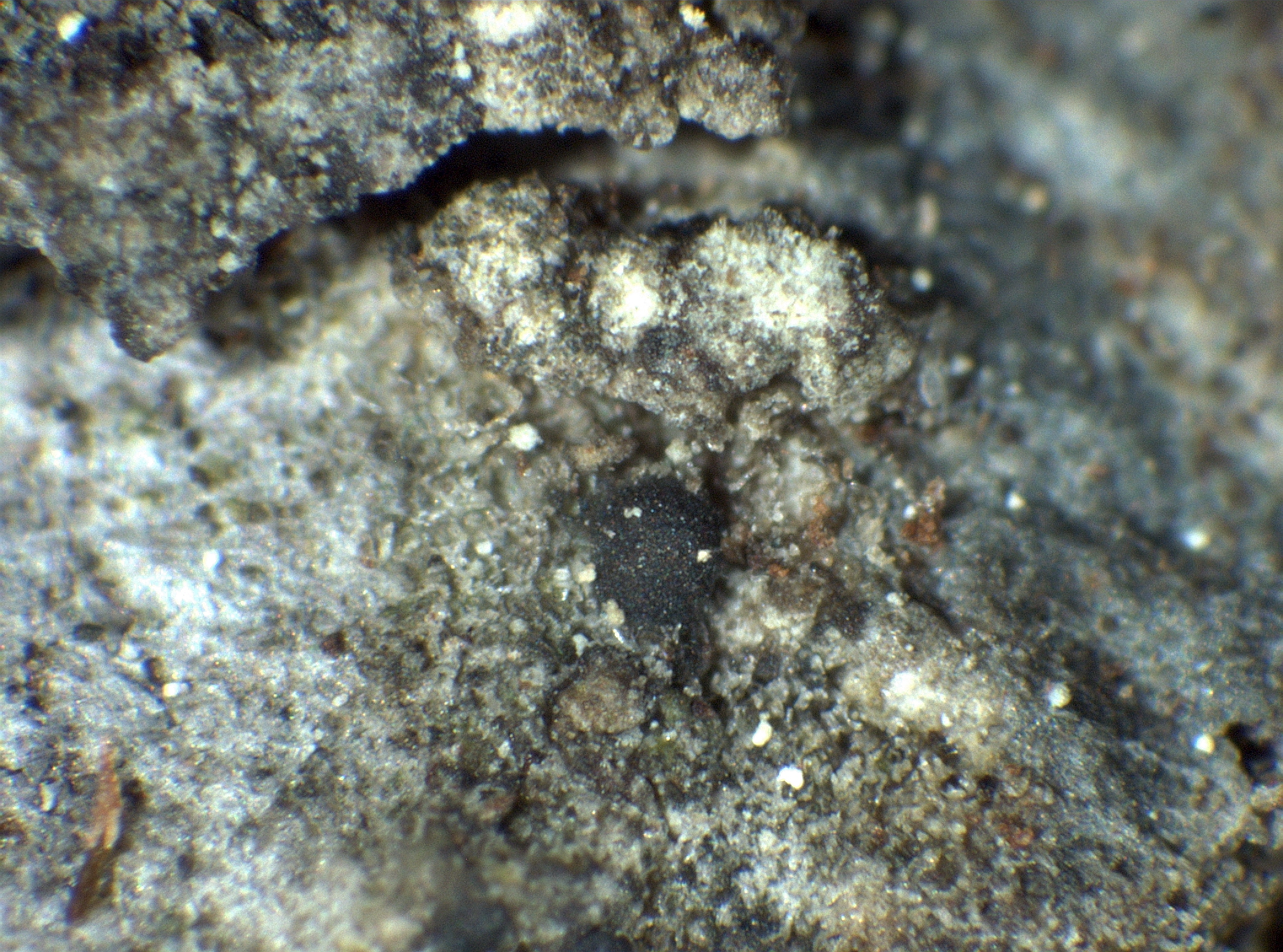
P.L.Nimis; Owner: Department of Life Sciences, University of Trieste
Herbarium: TSB (36847)
2008.02.25
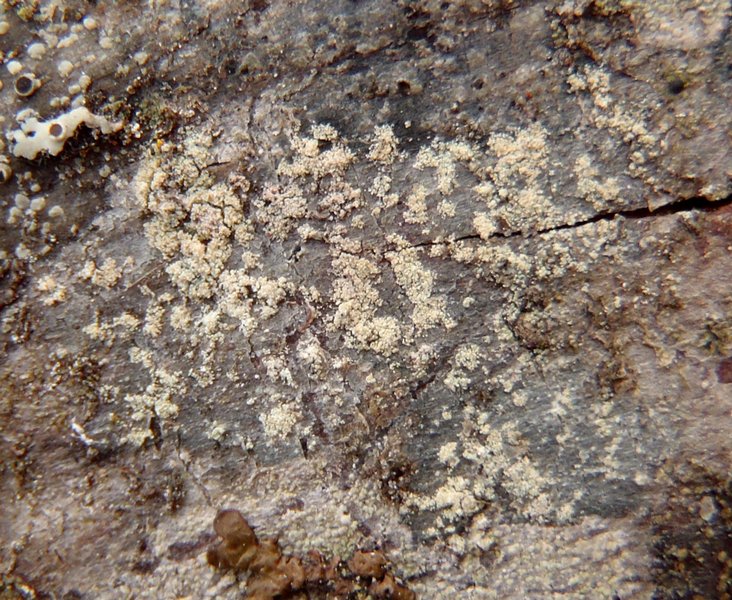
Curtis Randall Björk – CC BY-SA 4.0
British Columbia, Clearwater Valley Date: 2012-04-04 Corticolous on trunk of Alnus incana in garden